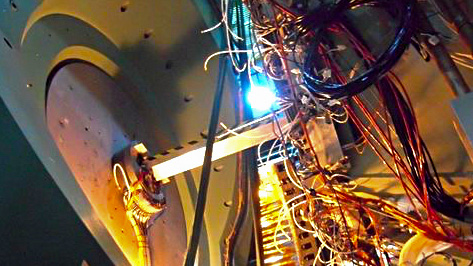
PHENIX at RHIC

PHENIX experiment at the Relativistic Heavy Ion Collider

Introduction / はじめに

Colliding protons and nuclei at RHIC

The PHENIX experiment was one of the major experiments at the Relativistic Heavy Ion Collider (RHIC) at Brookhaven National Laboratory. RHIC collided heavy nuclei to study strongly interacting matter at extreme temperature and also collided polarized protons to investigate the internal spin structure of the proton.

PHENIX was designed as a broad particle-physics detector with particular sensitivity to photons, electrons, muons, hadrons, and rare probes. Its physics program therefore connected two major questions in quantum chromodynamics (QCD): the properties of hot quark-gluon matter and the way quarks and gluons build the spin of the proton. [1], [2]

RHICで陽子と原子核を衝突させる

PHENIXは、米国ブルックヘブン国立研究所(Brookhaven National Laboratory)の相対論的重イオン衝突型加速器(RHIC)で 行われた主要実験の一つです。RHICでは重い原子核同士を衝突させて高温の強相互作用物質を調べると同時に、 偏極陽子同士を衝突させて陽子内部のスピン構造を研究しました。

PHENIXは光子、電子、ミュオン、ハドロンを幅広く測定するとともに、生成率の小さい希少な反応にも 感度を持つ汎用的な粒子検出器として設計されました。 そのため研究テーマは、量子色力学(QCD)における二つの大きな問題、 すなわち高温のクォーク・グルーオン物質の性質と、クォークやグルーオンが陽子スピンをどのように構成するかという問題に またがっていました。

Scope of this page / このページの位置づけ: This is a compact overview of PHENIX and of the physics questions connected with my earlier participation in the collaboration. It is not intended as a comprehensive review of the full PHENIX physics program. / ここでは、過去に参加していたPHENIX実験とその主要な物理テーマを簡潔に紹介します。 PHENIXの膨大な物理成果全体を網羅することは目的としていません。


Proton Spin Puzzle / 陽子スピン問題

Where does the proton get its spin?

The proton has spin $1/2$, but this does not mean that its spin is simply the sum of the spins of three static constituent quarks. Deep-inelastic scattering showed that the net polarization carried by quarks accounts for only part of the proton spin.

In QCD, the full spin can receive contributions from quark spin, gluon spin, and the orbital motion of quarks and gluons. The “proton spin puzzle” is therefore the experimental and theoretical program of determining how these components combine to produce the observed proton spin. [2]

陽子のスピンはどこから来るのか

陽子はスピン $1/2$ を持ちますが、その値を「静止した三つの構成クォークのスピンの単純な和」と考えることはできません。 深非弾性散乱実験によって、クォークが担う正味の偏極は陽子スピンの一部にすぎないことが分かりました。

QCDでは陽子スピンに、クォークのスピン、グルーオンのスピン、さらにクォークやグルーオンの軌道角運動量が寄与します。 「陽子スピン問題」とは、これらがどのように組み合わさって観測される陽子スピンを作るかを 実験と理論の両面から明らかにする研究です。

Why polarized proton collisions?

RHIC provided collisions in which the spin directions of the two proton beams were controlled. By reversing the beam helicities and comparing production rates, experiments measured spin-dependent cross sections while many detector effects largely cancelled in the ratio.

Different final states probe different aspects of the proton. Inclusive hadron and jet production constrain gluon polarization, while parity-violating $W^\pm$ production gives flavor-sensitive information on polarized quark and antiquark distributions. [2], [3]

なぜ偏極陽子衝突を使うのか

RHICでは二つの陽子ビームのスピン方向を制御した衝突を実現しました。 ビームのヘリシティ(進行方向に対するスピンの向き)を反転して生成率を比較することで、多くの検出器効果を比の中で相殺しながら スピンに依存する反応断面積を測定できます。

生成粒子によって異なる陽子内部構造を調べられます。包括的なハドロン生成やジェット生成は主にグルーオン偏極に、 パリティを破る $W^\pm$ 生成はクォーク・反クォークのフレーバーごとの偏極分布に感度を持ちます。


RHIC / 相対論的重イオン衝突型加速器

A collider for both QCD matter and spin

RHIC is a circular collider at Brookhaven National Laboratory with two independent storage rings. It was built to collide heavy ions such as gold at relativistic energies and became the first collider capable of doing so. It also developed the unique capability to accelerate and collide high-energy polarized proton beams.

This combination made RHIC unusual: the same accelerator could study QCD under extreme temperature and density through heavy-ion collisions, and the spin structure of ordinary matter through polarized proton collisions. [2]

QCD物質とスピンの両方を調べる衝突型加速器

RHICは米国ブルックヘブン国立研究所にある、二つの蓄積リングを備えた円形衝突型加速器です。 金のような重い原子核を相対論的エネルギーで衝突できる世界初の衝突型加速器として建設され、 さらに高エネルギーの偏極陽子ビームを加速・衝突させる独自の能力を持ちました。

このため同じ加速器で、重イオン衝突による極限温度・密度のQCD物質と、 偏極陽子衝突による通常物質のスピン構造という二つの異なる問題を研究できました。

Several collision systems

RHIC operated with many combinations of projectiles: proton-proton, gold-gold, deuteron-gold, copper-gold, helium-3–gold, and others. Comparing systems of different size and geometry is essential for separating effects caused by hot matter from those already present in ordinary nuclear collisions.

多様な衝突系

RHICでは陽子–陽子、金–金、重陽子–金、銅–金、ヘリウム3–金など、 多様な組み合わせで衝突実験が行われました。大きさや幾何学的条件の異なる系を比較することで、 高温物質による効果と通常の原子核衝突ですでに生じる効果を切り分けることができます。


PHENIX Experiment / PHENIX実験

A detector optimized for rare probes

PHENIX — the Pioneering High Energy Nuclear Interaction eXperiment — used several detector subsystems around one of the RHIC interaction points. Central detector arms measured photons, electrons, and charged hadrons near midrapidity, while forward and backward muon arms provided sensitivity to muons from weak bosons, quarkonia, and heavy-flavor decays.

The detector did not attempt to record every particle over the full solid angle. Instead, it combined strong particle identification, high-rate triggering, calorimetry, tracking, and muon detection to isolate selected observables with well-controlled backgrounds. [1]

希少な反応に強い検出器

PHENIX(Pioneering High Energy Nuclear Interaction eXperiment)は、RHICの衝突点の一つに 多数の粒子検出器を配置した実験です。中央検出器では衝突の中心付近(中央ラピディティ)の光子、電子、荷電ハドロンを、 前方・後方のミュオン検出器では弱い相互作用を媒介するボソン、クォーコニウム、チャームやボトムなど重いクォークを含む粒子の 崩壊に由来するミュオンを測定しました。

全立体角の全粒子を記録する設計ではなく、粒子識別、高計数率に対応するトリガー、 カロリメータ、飛跡検出器、ミュオン検出器を組み合わせ、特定の物理信号を背景事象から高精度に取り出す ことを重視した検出器でした。

From proton spin to heavy-ion physics

In polarized proton collisions, PHENIX measured spin asymmetries for final states including neutral mesons, heavy flavor, quarkonia, and $W$ bosons. In nuclear collisions, the same detector studied collective flow, electromagnetic probes, quarkonia, heavy flavor, and modifications of hadron production.

The strength of a large collider collaboration lies in combining many such observables: no single channel gives a complete picture of either the proton or the quark-gluon medium.

陽子スピンから重イオン物理まで

偏極陽子衝突では中性中間子、チャームやボトムなど重いクォークを含む粒子、クォーコニウム、 $W$ボソンなどの生成に対する スピン非対称度を測定しました。原子核衝突では集団流、光子やレプトンなどの電磁的プローブ、クォーコニウム、 重いクォークを含む粒子、ハドロン生成の変化などを調べました。

大型衝突型加速器実験の強みは、多数の観測量を組み合わせられることです。 陽子内部構造もクォーク・グルーオン物質も、一つの反応過程だけで全体像を決めることはできません。


Selected Physics Results / 代表的な物理成果

Spin-dependent production

One important part of the PHENIX spin program was the measurement of helicity-dependent particle production. For example, measurements of $W^\pm$ production use the parity-violating weak interaction to distinguish different quark flavors, while double-helicity asymmetries in processes such as inclusive $J/\psi$ production provide complementary constraints on spin-dependent parton distributions. [3], [4]

スピン依存粒子生成

PHENIXのスピン研究の重要な研究の一つが、ビームのヘリシティに依存する粒子生成率の測定でした。 たとえば $W^\pm$ 生成では弱い相互作用のパリティ非保存性を利用してクォークのフレーバーを区別でき、 包括的な $J/\psi$ 生成などの二重ヘリシティ非対称度は、スピンに依存するパートン分布に 相補的な制約を与えます。

Asymmetric nuclear collisions

PHENIX also exploited asymmetric collision systems such as Cu+Au, p+Au, and $^3$He+Au. These systems provide controlled changes in geometry and nuclear environment. Measurements of $J/\psi$, light hadrons, and collective-flow observables helped separate initial-state nuclear effects from the final-state dynamics of the produced matter. [5], [6]

非対称な原子核衝突

PHENIXではCu+Au、p+Au、$^3$He+Auのような非対称衝突系も利用しました。 これらは衝突の幾何学的条件や原子核環境を系統的に変えられる実験系です。$J/\psi$、軽いハドロン、 集団流などを比較することで、衝突前の原子核に由来する初期状態効果と、生成物質の終状態における時間発展を 切り分ける研究が行われました。

My Work in PHENIX / PHENIXでの活動: My work with PHENIX belongs mainly to an earlier stage of my research career. As a PHENIX member, I contributed to the drift-chamber upgrade and offline detector tests, and participated in several data-taking shifts. The publications listed below are collaboration results from that period rather than part of my current central research program. / PHENIXへの参加は主として研究キャリアの初期にあたります。ドリフトチェンバーの改修作業やオフラインテストに貢献したほか、複数回のデータ取得シフトに参加しました。


Current Context / 現在の位置づけ

Data taking completed, analysis preserved

PHENIX completed data taking in 2016. The collaboration has continued analysis of the large accumulated data set, especially for measurements with physics reach unique to PHENIX. The collaboration also maintains a substantial data- and analysis-preservation effort. [1]

RHIC physics has subsequently moved to newer detector programs, including sPHENIX, while PHENIX remains an important legacy data set for heavy-ion and spin physics.

データ取得終了後も続く解析

PHENIXのデータ取得は2016年に終了しました。その後も、PHENIXでしか得られない物理情報を含む 大規模なデータセットの解析が継続され、データと解析環境を長期保存する取り組みも進められています。

RHICではその後sPHENIXを含む新しい検出器による研究へ展開していますが、 PHENIXは重イオン物理・スピン物理の重要な研究資産として残っています。


References / 参考文献

  1. PHENIX Collaboration, “PHENIX Experiment: Concept and History.” PHENIX Collaboration website
  2. Brookhaven National Laboratory, “RHIC Spin Physics.” BNL RHIC
  3. A. Adare et al. (PHENIX Collaboration), “Measurement of parity-violating spin asymmetries in $W^\pm$ production at midrapidity in longitudinally polarized p+p collisions,” Physical Review D 93, 051103 (2016).
  4. A. Adare et al. (PHENIX Collaboration), “Measurements of double-helicity asymmetries in inclusive $J/\psi$ production in longitudinally polarized p+p collisions at $\sqrt{s}=510$ GeV,” Physical Review D 94, 112008 (2016). doi:10.1103/PhysRevD.94.112008
  5. A. Adare et al. (PHENIX Collaboration), “Nuclear matter effects on $J/\psi$ production in asymmetric Cu+Au collisions at $\sqrt{s_{NN}}=200$ GeV,” Physical Review C 90, 064908 (2014). doi:10.1103/PhysRevC.90.064908
  6. A. Adare et al. (PHENIX Collaboration), “Pseudorapidity Dependence of Particle Production and Elliptic Flow in Asymmetric Nuclear Collisions of p+Al, p+Au, d+Au, and $^3$He+Au at $\sqrt{s_{NN}}=200$ GeV,” Physical Review Letters 121, 222301 (2018). doi:10.1103/PhysRevLett.121.222301

Related Publications / 関連論文

Representative PHENIX Collaboration papers associated with my earlier participation are listed below. / 過去のPHENIX参加時期に関連する代表的な共同研究論文を示します。

Selected publications / 主な論文

  • 2018
    Pseudorapidity Dependence of Particle Production and Elliptic Flow in Asymmetric Nuclear Collisions of p+Al, p+Au, d+Au, and ³He+Au at √sNN = 200 GeV
    A. Adare et al. (PHENIX Collaboration) · Physical Review Letters 121, 222301
  • 2017
    Cross section and transverse single-spin asymmetry of muons from open heavy-flavor decays in polarized p+p collisions at √s = 200 GeV
    C. Aidala et al. (PHENIX Collaboration) · Physical Review D 95, 112001
  • 2016
    Measurements of double-helicity asymmetries in inclusive J/ψ production in longitudinally polarized p+p collisions at √s = 510 GeV
    A. Adare et al. (PHENIX Collaboration) · Physical Review D 94, 112008
  • 2014
    Nuclear matter effects on J/ψ production in asymmetric Cu+Au collisions at √sNN = 200 GeV
    A. Adare et al. (PHENIX Collaboration) · Physical Review C 90, 064908