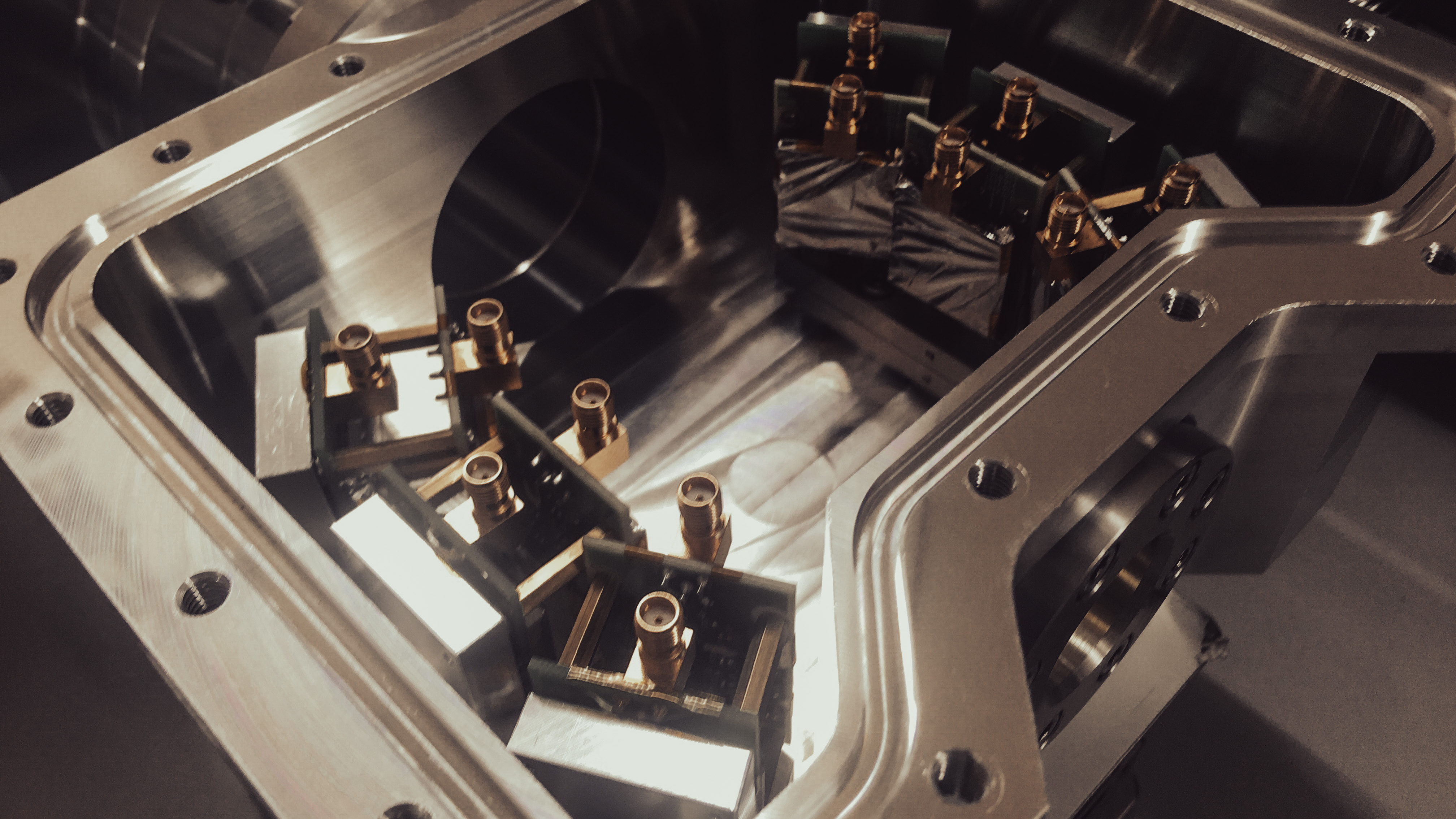
Weak interactions inside an exotic atom
A negative muon can be captured by a nucleus and form a compact exotic atom. Because the muon is about two hundred times heavier than the electron, its orbit is correspondingly much smaller and it probes the electromagnetic and weak fields close to the nucleus. This makes muonic atoms an unusual laboratory for precision tests at low energy.
Our long-term goal is to search for atomic parity violation (APV) in such systems. The observable of interest is a very small directional asymmetry in X-ray emission, produced when the weak interaction mixes atomic states of opposite parity. Reaching that measurement, however, requires us to understand how the muonic atom is formed, how it de-excites, how much spin polarization survives, and whether a useful metastable state remains. [1]