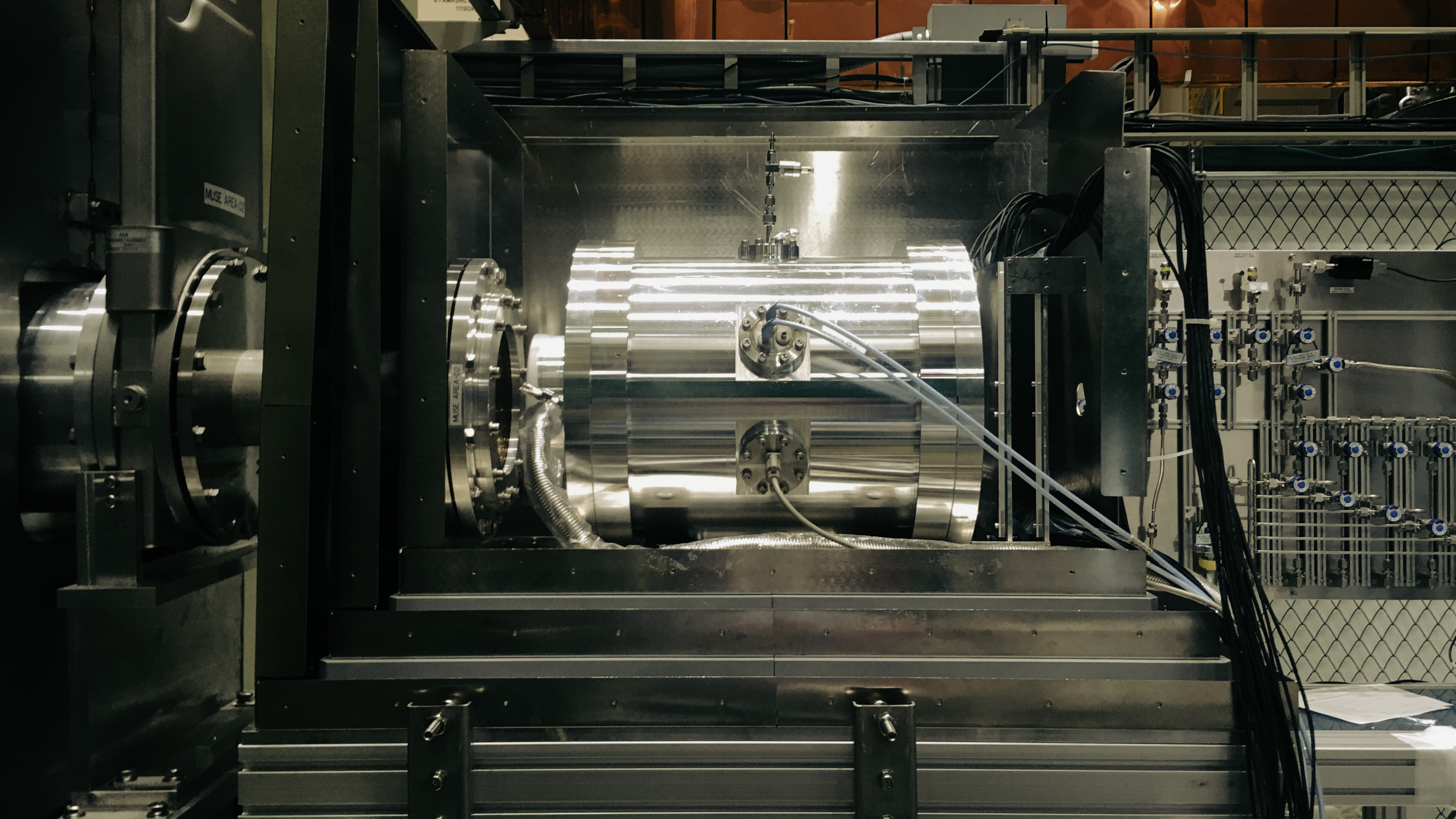
Microwave Spectroscopy of the Muonium Hyperfine Structure

Muonium hyperfine-structure spectroscopy

Introduction / はじめに

Precision spectroscopy with muons

Precision spectroscopy determines an atomic transition frequency and compares it with a theoretical prediction. Because frequency can be measured extremely accurately, a simple atomic system can become a sensitive test of the Standard Model and a tool for determining fundamental constants.

The MuSEUM experiment at J-PARC applies this idea to atoms containing a muon. Our main target is the ground-state hyperfine structure (HFS), a microwave-frequency splitting produced by the interaction between the magnetic moments of the muon and the electron. We study both muonium, which contains a positive muon, and muonic helium, which contains a negative muon. [1]

ミュオンを用いた精密分光

精密分光では、原子の遷移周波数を高精度で測定し、理論計算と比較します。周波数は非常に高い精度で 測ることができるため、単純な原子系を用いて標準模型を厳密に検証したり、基礎物理定数を決定したり することができます。

J-PARCのMuSEUM実験では、この方法をミュオンを含む原子に適用しています。主な測定対象は、 ミュオンと電子の磁気モーメントの相互作用によって生じる基底状態の超微細構造(HFS)です。 正ミュオンを含むミュオニウムと、負ミュオンを含むミュオンヘリウムの両方を研究しています。


Why Hyperfine Spectroscopy? / なぜ超微細構造を測るのか

A laboratory for bound-state QED

Muonium is made only of two leptons: a positive muon and an electron. Unlike ordinary hydrogen, it contains no composite nucleus whose finite size complicates the calculation. Its energy levels can therefore be calculated with unusually high precision in bound-state quantum electrodynamics (QED).

The HFS is dominated by the magnetic interaction between the two particles, with smaller corrections from higher-order QED, electroweak interactions, and hadronic vacuum polarization. Improving the experiment therefore tests increasingly small contributions to the Standard Model. [1], [2]

束縛系QEDの精密検証

ミュオニウムは正ミュオンと電子という二つのレプトンだけで構成されています。通常の水素原子と異なり、 有限の大きさを持つ複合粒子としての原子核を含まないため、束縛系量子電磁力学(QED)によって エネルギー準位を非常に高い精度で計算できます。

HFSの主成分は二つの粒子の磁気的相互作用ですが、より高次のQED効果、電弱相互作用、 ハドロン真空偏極なども小さな補正として含まれます。実験精度を高めることは、標準模型に含まれる こうした微小な効果を順に検証していくことに相当します。

Fundamental constants and new physics

Hyperfine spectroscopy is also closely connected to the muon magnetic moment and mass. In the most precise previous high-field measurement, the muonium HFS was determined to 12 parts per billion and the muon-to-proton magnetic-moment ratio to about 120 parts per billion. These constants enter other precision experiments, including measurements of the muon anomalous magnetic moment.

Muonium spectroscopy also provides sensitivity to possible interactions beyond the Standard Model. The same precision that makes the system useful for QED tests can be used to constrain new muon-specific forces, Lorentz- or CPT-violating effects, and other weak interactions that would shift the transition frequency. [1], [5]

基礎定数と新しい物理

超微細構造分光は、ミュオンの磁気モーメントや質量の決定とも密接に関係しています。従来の最も精密な 高磁場測定では、ミュオニウムHFSは12 ppb、ミュオンと陽子の磁気モーメント比は約120 ppbの精度で 決定されました。これらの定数は、ミュオン異常磁気能率など他の精密測定にも現れます。

また、ミュオニウム分光は標準模型を超える相互作用の探索にも利用できます。QED検証を可能にする 高い精度をそのまま、新しいミュオン特異的な力、Lorentz対称性やCPT対称性の破れなど、 遷移周波数にごく小さな変化を与える効果の探索に用いることができます。


Muonium and Muonic Helium / ミュオニウムとミュオンヘリウム

Muonium: a purely leptonic atom

Muonium (Mu) is a hydrogen-like atom consisting of a positive muon and an electron. The positive muon plays the role normally occupied by a proton, but it is itself an elementary particle. This makes muonium a particularly clean two-body system.

The muon lifetime is only about 2.2 μs, so the atom disappears shortly after it is formed. This is long enough for microwave spectroscopy, but it also means that the experiment must create, manipulate, and detect a large number of atoms within a few microseconds. [2]

ミュオニウム:レプトンだけからなる原子

ミュオニウム(Mu)は正ミュオンと電子からなる水素様原子です。通常の水素で陽子が占める位置に 正ミュオンがありますが、ミュオン自身も素粒子であるため、非常に単純な二体系として扱うことができます。

ミュオンの寿命は約2.2 μsしかないため、生成された原子は短時間で消滅します。それでもマイクロ波分光を 行うには十分な長さですが、数マイクロ秒のうちに多数の原子を生成し、状態を操作し、崩壊粒子を検出する 必要があります。

Muonic helium: a complementary system with a negative muon

In muonic helium, a negative muon is captured by a helium nucleus and orbits so close to it that it screens almost one unit of nuclear charge. Together they behave approximately as a compact positive “pseudonucleus,” around which one electron remains. The resulting atom is hydrogen-like, but its internal structure is a genuine three-body problem.

Measuring its HFS tests calculations of this three-body system and gives access to the magnetic moment and mass of the negative muon. Comparing the corresponding quantities for positive and negative muons provides a conceptually direct test of CPT symmetry in the second lepton generation. [1], [3]

ミュオンヘリウム:負ミュオンによる相補的な原子系

ミュオンヘリウムでは、負ミュオンがヘリウム原子核に捕獲され、非常に小さな軌道を回ることで 原子核の正電荷をほぼ1個分遮蔽します。原子核と負ミュオンはコンパクトな正電荷の「擬似原子核」の ように振る舞い、その外側に電子が一つ残るため、全体として水素様の原子になります。 一方で内部は本質的に三体系です。

そのHFSを測ることで三体系の束縛状態計算を検証するとともに、負ミュオンの磁気モーメントと質量を 調べることができます。正負ミュオンで対応する物理量を比較することは、第2世代レプトンにおける CPT対称性の直接的な検証にもつながります。


Hyperfine Structure and Microwave Transitions / 超微細構造とマイクロ波遷移

Spin coupling in the ground state

In the ground state of muonium, the electron and muon spins can be aligned or anti-aligned. Their magnetic interaction separates these configurations into a triplet state and a singlet state. The energy difference corresponds to a microwave frequency near 4.463 GHz.

At nearly zero external field, the HFS can be measured directly by driving the transition between the two hyperfine manifolds. A resonant microwave magnetic field changes the muon spin state, and the transition is detected through the angular distribution of positrons from muon decay.

基底状態のスピン結合

ミュオニウムの基底状態では、電子とミュオンのスピンが平行または反平行に結合します。両者の磁気的 相互作用によってtriplet状態とsinglet状態にエネルギー差が生じ、その大きさは約4.463 GHzの マイクロ波周波数に対応します。

外部磁場がほぼゼロの場合、この二つの超微細状態間の遷移を直接励起してHFSを測定できます。 共鳴するマイクロ波磁場によってミュオンのスピン状態が変化し、その変化をミュオン崩壊で放出される 陽電子の角度分布から読み出します。

What changes in a magnetic field?

A static magnetic field splits the ground state into four Zeeman sublevels. Instead of one zero-field resonance, two spin-flip transition frequencies, conventionally called $\nu_{12}$ and $\nu_{34}$, are measured. Their combination separates two pieces of information:

$$\Delta\nu_{\mathrm{HFS}} = \nu_{12} + \nu_{34}$$ $$\frac{\mu_\mu}{\mu_p} \;\text{is determined mainly from}\; \nu_{34}-\nu_{12}.$$

The sum gives the zero-field hyperfine interval, while the difference is strongly sensitive to the muon magnetic moment. This is why high-field spectroscopy can determine both the HFS and a fundamental muon property in the same experiment. [1]

磁場をかけると何が変わるか

静磁場を加えると、基底状態はZeeman効果によって四つの準位に分かれます。この場合はゼロ磁場の 一つの共鳴ではなく、通常 $\nu_{12}$、$\nu_{34}$ と呼ぶ二つのスピン反転遷移を測定します。 二つの周波数を組み合わせることで、異なる物理量を分離できます。

$$\Delta\nu_{\mathrm{HFS}} = \nu_{12} + \nu_{34}$$ $$\frac{\mu_\mu}{\mu_p} \;\text{は主として}\; \nu_{34}-\nu_{12} \;\text{から決まります。}$$

和はゼロ磁場でのHFSに対応し、差はミュオン磁気モーメントに強く依存します。このため高磁場分光では、 一つの実験からHFSとミュオンの基礎的な性質を同時に高精度で決定できます。


Experimental Method at J-PARC / J-PARCでの測定方法

From a pulsed muon beam to a resonance signal

A high-intensity pulsed muon beam is injected into a gas target placed inside a microwave cavity. For muonium measurements, positive muons are stopped in high-purity krypton and form polarized muonium through charge exchange. Microwaves are applied to the atoms while they remain inside the cavity.

Muons decay preferentially along their spin direction, so a microwave-induced spin flip changes the angular distribution of decay positrons. Segmented scintillation detectors placed around the target record this change. By comparing data with the microwave on and off while scanning the frequency, we obtain the resonance line. [1], [2]

パルスミュオンから共鳴信号まで

高強度のパルスミュオンビームを、マイクロ波共振器の内部に置いたガス標的へ入射します。 ミュオニウム測定では、正ミュオンを高純度Krガス中に停止させ、電荷交換によってスピン偏極した ミュオニウムを生成します。原子が共振器内に存在する間にマイクロ波を照射します。

ミュオン崩壊で生じる陽電子はミュオンスピンの向きに偏って放出されるため、マイクロ波による スピン反転は陽電子の角度分布の変化として観測できます。標的の周囲に配置した分割型シンチレーション 検出器でこの変化を測り、マイクロ波ON/OFFを比較しながら周波数を走査することで共鳴曲線を得ます。

Why a pulsed beam is useful

At J-PARC, many muons arrive together in a short pulse. This creates a high instantaneous counting rate, but it also gives a well-defined time origin. Instead of treating every atom only as an integrated event, the experiment can follow the time evolution of the spin response.

This leads to Rabi-oscillation spectroscopy: the time-dependent microwave response is fitted directly, providing information on both the resonance frequency and the effective microwave field. The method turns the pulsed time structure from a complication into an additional experimental observable. [4]

パルスビームを利用する利点

J-PARCでは多数のミュオンが短い時間幅のパルスとして到来します。瞬間的な計数率は高くなりますが、 同時に測定の時間原点が明確になります。そのため、単に全時間を積分したイベント数だけでなく、 マイクロ波に対するスピン応答の時間発展そのものを観測できます。

これを利用するのがRabi振動分光です。時間依存する信号を直接フィットすることで、共鳴周波数と 実効的なマイクロ波磁場の両方を評価できます。パルスビーム特有の時間構造を、制約ではなく追加の 観測量として利用する方法です。

Muonium and muonic helium / ミュオニウムとミュオンヘリウム: The basic microwave and decay-asymmetry method is common to both systems. For muonic helium, polarized negative muons are stopped in helium gas, and a small CH4 admixture is used as an electron donor to efficiently form neutral muonic helium. The decay-electron asymmetry then plays the role of the positron asymmetry used for positive muons. / 基本的なマイクロ波励起と崩壊粒子の非対称度測定は共通です。ミュオンヘリウムでは偏極した負ミュオンを Heガスに停止させ、少量のCH4を電子供与体として加えることで中性ミュオンヘリウムを効率よく 生成し、正ミュオンの陽電子に対応して崩壊電子の角度分布を読み出します。


Near-Zero-Field Results / ほぼゼロ磁場での測定

Muonium: establishing pulsed-beam precision spectroscopy

The first major milestone was a direct measurement of the muonium HFS at near-zero magnetic field using the high-intensity pulsed beam at J-PARC. The resonance was clearly observed with a high-rate positron detector, giving $\Delta\nu_{\mathrm{HFS}} = 4.463302(4)$ GHz, corresponding to a relative precision of 0.9 ppm. [2]

The result agrees with earlier high-precision measurements and with the theoretical expectation. More importantly for the next stage, it demonstrated that precision microwave spectroscopy can be performed with a high-intensity pulsed muon beam while retaining the spin information in the decay time spectrum.

ミュオニウム:パルスビーム精密分光の実証

最初の大きなマイルストーンは、J-PARCの高強度パルスミュオンビームを用いた、ほぼゼロ磁場での ミュオニウムHFS直接測定です。高計数率に対応した陽電子検出器によって共鳴を明瞭に観測し、 $\Delta\nu_{\mathrm{HFS}} = 4.463302(4)$ GHz、相対精度0.9 ppmを得ました。

この結果は過去の高精度測定および理論値と整合しました。それ以上に重要なのは、高強度パルスビームを 用いても、崩壊時間スペクトルに含まれるスピン情報を保持したまま精密マイクロ波分光が可能であることを 実証した点です。

Muonic helium: a new direct measurement

The same experimental concept was extended to muonic helium. Using CH4 as an electron donor, the experiment obtained $\Delta\nu_{\mathrm{HFS}} = 4464.979(20)$ MHz, or 4.5 ppm, at near-zero magnetic field. This improved on both previous weak-field and high-field measurements. [3]

Muonium was also measured under closely related gas conditions, allowing the gas-density dependence to be compared between the light and heavy hydrogen-like systems. No isotopic effect was resolved at the present precision.

ミュオンヘリウム:新しい直接測定

同じ測定原理をミュオンヘリウムにも拡張しました。電子供与体としてCH4を用いることで、 ほぼゼロ磁場において $\Delta\nu_{\mathrm{HFS}} = 4464.979(20)$ MHz、すなわち4.5 ppmの測定精度を得ました。 これは過去の弱磁場・高磁場のいずれの測定よりも高い精度です。

さらに近いガス条件でミュオニウムも測定し、「軽い水素様原子」と「重い水素様原子」の間で ガス密度による周波数シフトを比較しました。現在の測定精度では、明確な同位体効果は観測されていません。


High-Field Program / 高磁場での高精度測定

Two transition frequencies, two physical quantities

The high-field phase is designed to go beyond the direct zero-field measurement. In a strong magnetic field, the two transition frequencies $\nu_{12}$ and $\nu_{34}$ can be measured separately. Their sum determines the HFS, while their difference provides the muon magnetic moment relative to the proton.

Measuring at more than one field strength is particularly useful. Different magnetic fields change the sensitivity to field calibration, field inhomogeneity, microwave-cavity properties, and other systematic effects. The program therefore uses measurements at several fields as an internal cross-check rather than relying on a single operating point. [1]

二つの遷移周波数から二つの物理量へ

高磁場での測定は、ゼロ磁場でHFSを直接測る方法からさらに精度を高めるための次の段階です。 強磁場中では $\nu_{12}$ と $\nu_{34}$ の二つの遷移を個別に測定できます。その和からHFSを、 差からミュオンと陽子の磁気モーメント比を求めます。

複数の磁場強度で測定することにも重要な意味があります。磁場を変えると、磁場校正や不均一性、 マイクロ波共振器の特性など、さまざまな系統誤差への感度が変化します。そのため一つの条件だけに 依存せず、異なる磁場で得た結果を相互に比較することで測定の内部整合性を検証できます。

Magnetic-field metrology and microwave control

Reaching the ppb regime requires the spectroscopy apparatus and the magnetic-field measurement to be treated as one system. The high-field setup combines a large superconducting solenoid, precision NMR probes, beam-profile information, and microwave cavities optimized for the two transition frequencies.

Dual-mode cavities and Rabi-oscillation analysis are being developed to control the microwave field and to reduce sensitivity to nonuniform excitation. Together with measurements at different static fields, these techniques are intended to improve the muonium HFS and magnetic moment by about an order of magnitude over the previous high-field result. Muonic helium uses the same core strategy, with the longer-term goal of a much larger improvement over the statistics-limited measurements of the 1980s. [1], [6]

磁場計測とマイクロ波制御

ppb領域を目指すには、分光装置と磁場計測を一体のシステムとして扱う必要があります。高磁場装置では、 大型超伝導ソレノイド、高精度NMRプローブ、ビームプロファイル測定、二つの遷移周波数に対応した マイクロ波共振器を組み合わせます。

マイクロ波磁場の制御と励起の不均一性低減のため、dual-mode共振器やRabi振動解析も開発しています。 複数の静磁場での測定と組み合わせることで、ミュオニウムHFSと磁気モーメントについて従来の高磁場測定を 約1桁上回る精度を目指します。ミュオンヘリウムでも同じ基本戦略を用い、統計誤差に支配されていた 1980年代の測定を大幅に更新することを目標としています。

Why study both signs of the muon? / なぜ正負両方のミュオンを調べるのか: Muonium and muonic helium use very similar microwave techniques but probe the positive and negative muon, respectively. Improving both measurements creates a common precision framework for bound-state QED, muon fundamental constants, and comparisons between matter and antimatter partners in the second lepton generation. / ミュオニウムとミュオンヘリウムはよく似たマイクロ波分光法を用いながら、それぞれ正ミュオンと 負ミュオンを調べます。両者を高精度化することで、束縛系QED、ミュオン基礎定数、第2世代レプトンの 正負比較を同じ実験的枠組みで進めることができます。


References / 参考文献

  1. P. Strasser et al., “Precision measurements of muonium and muonic helium hyperfine structure at J-PARC,” European Physical Journal D 79, 20 (2025). doi:10.1140/epjd/s10053-025-00959-2
  2. S. Kanda et al., “New precise spectroscopy of the hyperfine structure in muonium with a high-intensity pulsed muon beam,” Physics Letters B 815, 136154 (2021). doi:10.1016/j.physletb.2021.136154
  3. P. Strasser et al., “Improved Measurements of Muonic Helium Ground-State Hyperfine Structure at a Near-Zero Magnetic Field,” Physical Review Letters 131, 253003 (2023). doi:10.1103/PhysRevLett.131.253003
  4. S. Nishimura et al., “Rabi-oscillation spectroscopy of the hyperfine structure of muonium atoms,” Physical Review A 104, L020801 (2021). doi:10.1103/PhysRevA.104.L020801
  5. W. Liu et al., “High Precision Measurements of the Ground State Hyperfine Structure Interval of Muonium and of the Muon Magnetic Moment,” Physical Review Letters 82, 711 (1999). doi:10.1103/PhysRevLett.82.711
  6. R. Iwai et al., “Dual-mode rectangular microwave cavity for precision spectroscopy of hyperfine structure in muonium,” Nuclear Instruments and Methods in Physics Research A 1064, 169434 (2024). doi:10.1016/j.nima.2024.169434

Related Publications & Presentations / 関連論文・発表

Selected papers and presentations directly connected to the MuSEUM microwave-spectroscopy program are listed below. / MuSEUMのマイクロ波分光に直接関係する主な論文・発表をまとめます。

Publications / 論文

  • 2025
    Precision measurements of muonium and muonic helium hyperfine structure at J-PARC
    P. Strasser et al. · European Physical Journal D 79, 20
  • 2024
    Dual-mode rectangular microwave cavity for precision spectroscopy of hyperfine structure in muonium
    R. Iwai et al. · Nuclear Instruments and Methods in Physics Research A 1064, 169434
  • 2023
    Improved Measurements of Muonic Helium Ground-State Hyperfine Structure at a Near-Zero Magnetic Field
    P. Strasser et al. · Physical Review Letters 131, 253003
  • 2021
    New precise spectroscopy of the hyperfine structure in muonium with a high-intensity pulsed muon beam
    S. Kanda et al. · Physics Letters B 815, 136154
  • 2021
    Rabi-oscillation spectroscopy of the hyperfine structure of muonium atoms
    S. Nishimura et al. · Physical Review A 104, L020801

Selected presentations / 主な発表

  • 2022
    New precise spectroscopy of the hyperfine structure in muonium with a high-intensity pulsed muon beam
    PSAS2022 · Warsaw · May 2022
  • 2017
    Direct observation of muonium ground state hyperfine structure at J-PARC
    HINT2016 · Tokai · 2017
  • 2016
    Direct measurement of muonium hyperfine splitting at J-PARC
    INPC2016 · Adelaide · October 2016
  • 2015
    Direct measurement of muonium ground state hyperfine splitting at zero magnetic field
    HINT2015 · Tokai · October 2015
  • 2014
    Precision Measurement of Muonium Hyperfine Splitting at J-PARC
    EGAS45 · Lille · July 2014