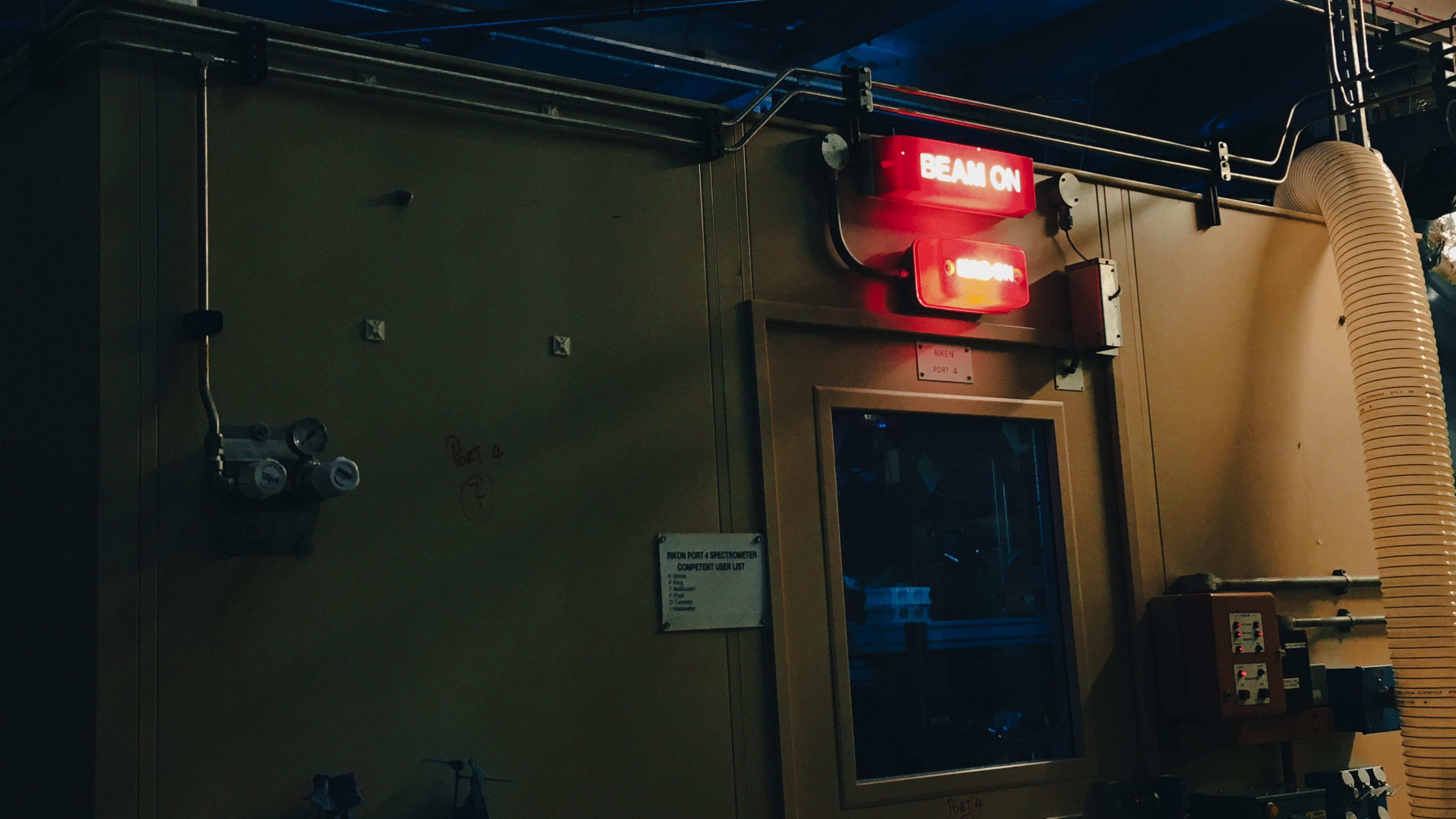
Laser Spectroscopy of the Muonic Hydrogen Hyperfine Structure

Muonic-hydrogen hyperfine spectroscopy

Introduction / はじめに

A tiny atom for measuring proton structure

Muonic hydrogen, usually written $\mu p$, is a bound state of a negative muon and a proton. It is chemically analogous to hydrogen, but the muon is about two hundred times heavier than the electron. The Bohr orbit is therefore much smaller, and the muon wave function overlaps strongly with the proton.

This large overlap amplifies the effect of the proton's finite size on the atomic energy levels. The Lamb shift is mainly sensitive to the proton charge radius, while the ground-state hyperfine splitting (HFS) is sensitive to the combined spatial distributions of charge and magnetization. Measuring both provides complementary information on proton structure. [1], [2]

小さな原子から陽子構造を測る

ミュオン水素($\mu p$)は、負ミュオンと陽子からなる束縛状態です。化学的には水素原子に対応しますが、 ミュオンは電子のおよそ200倍重いためBohr軌道がはるかに小さく、ミュオンの波動関数は陽子と強く重なります。

この大きな重なりによって、陽子が有限の大きさを持つ効果が原子エネルギー準位に強く現れます。 Lamb shiftは主に陽子の電荷半径に、基底状態の超微細構造(HFS)は電荷分布と磁気モーメント分布の 空間的重なりに敏感です。両者を測ることで、陽子構造を相補的に調べることができます。


Proton Radius Puzzle / 陽子半径問題

The lesson from the charge radius

In 2010, laser spectroscopy of muonic hydrogen produced a proton charge radius that was substantially smaller than the values then inferred from electronic hydrogen and electron-proton scattering. This discrepancy became known as the proton radius puzzle and triggered a broad re-examination of atomic theory, spectroscopy, scattering data, and possible new interactions.

More recent electronic measurements and analyses have substantially narrowed the original charge-radius discrepancy. The episode nevertheless demonstrated the exceptional sensitivity of muonic atoms to proton structure. It also motivates an independent test using a different proton observable rather than repeating only the charge-radius measurement. [1], [2], [3]

電荷半径問題が残したもの

2010年、ミュオン水素のレーザー分光から得られた陽子電荷半径は、当時の通常水素分光や 電子–陽子散乱から得られた値より大きくずれていました。この問題は「proton radius puzzle」と呼ばれ、 原子理論、分光、散乱データ、新しい相互作用の可能性まで幅広い再検討を促しました。

その後の電子系の測定や解析により、当初の電荷半径の不一致は大きく縮小しました。 しかしこの経緯は、ミュオン原子が陽子構造に極めて高い感度を持つことを示しました。 そこで同じ電荷半径を繰り返し測るだけでなく、別の陽子構造量を独立に調べることに意味があります。

Why the Zemach radius?

The charge radius describes only the spatial distribution of electric charge. The proton also has a magnetic-moment distribution. The Zemach radius combines these two distributions and therefore probes a different aspect of proton structure.

Compared with the charge radius, direct experimental information on the Zemach radius remains much more limited. Muonic-hydrogen HFS provides a particularly sensitive route because the finite-size contribution to the 1S splitting is large on the scale of the desired spectroscopy. [4], [5]

なぜZemach半径を測るのか

電荷半径は陽子内部の電荷分布だけを表します。陽子には磁気モーメントの空間分布もあり、 Zemach半径は電荷分布と磁気モーメント分布を重ね合わせた量です。そのため電荷半径とは異なる 陽子構造の側面を調べることができます。

電荷半径に比べると、Zemach半径についての直接的な実験情報は現在も限られています。 ミュオン水素の1S HFSでは有限サイズ効果が大きく現れるため、Zemach半径を高感度で調べる 有力な方法になります。


Muonic Hydrogen and the Zemach Radius / ミュオン水素とZemach半径

Ground-state hyperfine structure

The proton and muon both have spin $1/2$. Their magnetic interaction splits the 1S ground state into states with total spin $F=0$ and $F=1$. The splitting is about 183 meV, corresponding to mid-infrared light near 6.8 μm.

The leading contribution is the point-particle Fermi energy, followed by QED and proton-structure corrections. Among the proton terms, the Zemach contribution is particularly large. Schematically,

$$E_{\mathrm{HFS}} = E_F\left(1+\delta_{\mathrm{QED}}+\delta_{\mathrm{proton}}\right).$$

[4], [5]

基底状態の超微細構造

陽子とミュオンはいずれもスピン $1/2$ を持ち、その磁気的相互作用によって1S基底状態は 全スピン $F=0$ と $F=1$ に分裂します。このエネルギー差は約183 meVで、 波長約6.8 μmの中赤外光に対応します。

主成分は点粒子近似で得られるFermi energyで、そこにQED補正と陽子構造に由来する補正が加わります。 陽子構造項の中ではZemach補正が特に大きな寄与を持ちます。概念的には

$$E_{\mathrm{HFS}} = E_F\left(1+\delta_{\mathrm{QED}}+\delta_{\mathrm{proton}}\right)$$

と表せます。

The Zemach radius as an overlap of two distributions

The Zemach radius can be written as a convolution of the normalized electric-charge density $\rho_E$ and magnetic-moment density $\rho_M$:

$$R_Z = \int d^3r\int d^3r'\, \rho_E(\mathbf{r}')\rho_M(\mathbf{r}-\mathbf{r}').$$

It is therefore not simply a second measurement of the charge radius. It quantifies how the proton's electric and magnetic structures overlap in space. The HFS converts this spatial information into a measurable transition energy.

二つの分布の重なりとしてのZemach半径

Zemach半径は、規格化した電荷密度 $\rho_E$ と磁気モーメント密度 $\rho_M$ の畳み込みとして

$$R_Z = \int d^3r\int d^3r'\, \rho_E(\mathbf{r}')\rho_M(\mathbf{r}-\mathbf{r}')$$

と書けます。したがって単に「もう一度電荷半径を測る」量ではなく、陽子内部の電気的構造と磁気的構造が 空間的にどのように重なっているかを表します。HFS測定はこの空間情報を遷移エネルギーとして読み出します。


Laser Spectroscopy of the 1S HFS / 1S HFSのレーザー分光

Detecting a laser-induced muon spin flip

The J-PARC/RIKEN approach detects the hyperfine transition through the muon spin rather than through an X-ray emitted by another atom. After the muonic hydrogen has reached the ground state, a resonant 6.8-μm laser pulse drives the $F=0\rightarrow F=1$ transition. The transition changes the correlation between the muon spin and the proton spin.

Muon decay itself provides the spin analyzer. Electrons from negative-muon decay are emitted anisotropically with respect to the muon-spin direction. We therefore compare the time-dependent electron counts in detectors on opposite sides of the target. Scanning the laser frequency produces a resonance in the decay-electron asymmetry. [6]

レーザーによるミュオンスピン反転を検出する

J-PARC/RIKENの方式では、別の原子から出るX線ではなく、ミュオン自身のスピンを使ってHFS遷移を検出します。 ミュオン水素が基底状態まで脱励起した後、共鳴する6.8 μmレーザーパルスで $F=0\rightarrow F=1$ 遷移を励起します。この遷移によってミュオンと陽子のスピン相関が変化します。

スピン解析器として利用するのはミュオン崩壊そのものです。負ミュオンの崩壊電子はミュオンスピンに対して 異方的に放出されるため、標的の前後など反対側に置いた検出器の時間スペクトルを比較します。 レーザー周波数を走査すると、崩壊電子の非対称度に共鳴構造が現れます。

Complementary approaches / 相補的な三つの方法: Muonic-hydrogen HFS is being pursued with different experimental signatures: transfer to another atom followed by X-rays (FAMU), diffusion to a wall followed by X-rays (Hyper-Mu), and direct decay-electron asymmetry (RIKEN/J-PARC). The different observables provide useful cross-checks because they have different systematic limitations. / ミュオン水素HFSには、他原子へのtransfer後のX線を使うFAMU、拡散後のX線を使うHyper-Mu、 崩壊電子非対称度を直接使うRIKEN/J-PARCという異なるアプローチがあります。観測量と系統誤差が異なるため、 相互比較そのものにも大きな意味があります。


Experimental Setup / 実験装置

Cryogenic hydrogen target

A pulsed negative-muon beam is injected into a low-density hydrogen-gas target. The target is cooled to about 20 K with a pulse-tube cryostat so that collisional processes can be controlled at a density low enough for spectroscopy. The gas density is monitored with a precision pressure gauge, and the target cell uses tungsten to help suppress backgrounds from muons stopping outside the hydrogen.

Inside the target, the mid-infrared light is reflected repeatedly between mirrors in a non-resonant multipass geometry. This increases the optical path through the small volume occupied by the short-lived muonic hydrogen and thereby increases the laser-interaction probability without relying on resonant optical enhancement. [6], [8]

極低温水素ガス標的

パルス負ミュオンビームを低密度の水素ガス標的へ入射します。標的はpulse-tube冷凍機で約20 Kまで冷却し、 分光に必要な低密度を保ちながら衝突過程を制御します。ガス密度は高精度圧力計で監視し、 水素以外の場所に停止したミュオンからの背景を抑えるため、標的セルにはタングステンを用います。

標的内部では中赤外光をミラー間で何度も反射させるnon-resonant multipass配置を用います。 短寿命のミュオン水素が存在する小さな体積を光が繰り返し通過することで、resonantな光増強に頼らず レーザーと原子の相互作用確率を高めます。

Generating the 6.8-μm pulse

The required transition lies in the mid-infrared, where simultaneously obtaining high pulse energy, narrow linewidth, and tunability is difficult. The developed scheme separates these roles. A Q-switched Tm,Ho:YAG ceramic laser provides a strong pulse near 2.09 μm, while a quantum-cascade laser provides a narrow 6.778-μm seed.

Nonlinear conversion in ZnGeP2 optical-parametric stages transfers the energy of the pump into the wavelength region required for the HFS. The pump source has demonstrated more than 20 mJ with a pulse width below 150 ns, and the seed source has demonstrated 25 mW near 6.778 μm. The full system is designed to deliver a high-energy, frequency-controlled pulse to the hydrogen target. [7]

6.8 μmパルスの生成

HFS遷移は中赤外領域にあり、高パルスエネルギー、狭線幅、周波数可変性を同時に実現することが難しい 波長帯です。そこで役割を分けたレーザーシステムを開発しています。Q-switch Tm,Ho:YAG ceramic laserで 約2.09 μmの高エネルギーパルスを作り、quantum cascade laserで6.778 μmの狭線幅seed光を作ります。

ZnGeP2を用いた光パラメトリック変換でpump光のエネルギーをHFS波長へ移します。 pump sourceでは20 mJ超・150 ns未満のパルス性能を、seed sourceでは6.778 μm付近で25 mWを 実証しています。最終的には、周波数制御した高エネルギー6.8 μmパルスを水素標的へ導入する構成です。

Electron detector

The muon-spin signal is measured with segmented plastic-scintillator detectors read out by silicon photomultipliers. Fast front-end electronics and coincidence analysis suppress backgrounds from muons that stop in the target chamber or other beamline components. Prototype detectors have been tested with a negative-muon beam at RIKEN-RAL.

崩壊電子検出器

ミュオンスピン信号は、プラスチックシンチレータを分割しSiPMで読み出す検出器で測定します。 高速front-end electronicsとcoincidence解析を用いて、標的チェンバーや周辺ビームライン部品に 停止したミュオンによる背景を抑えます。プロトタイプ検出器はRIKEN-RALの負ミュオンビームで試験しています。


Cascade and Collisional Quenching / カスケードと衝突脱励起

Preparing the atomic state before the laser arrives

A negative muon captured by hydrogen initially occupies a highly excited state around $n\sim14$. It then cascades to 1S through radiative transitions, Auger emission, Stark mixing, elastic collisions, and Coulomb de-excitation. These processes determine the kinetic-energy distribution and residual spin polarization of the ground-state $\mu p$ ensemble.

For precision spectroscopy, the cascade is therefore part of the state preparation. A laser pulse applied at a fixed delay after the muon pulse interacts not with an ideal atom at rest, but with an ensemble whose velocity, spin population, and collision history have been set by the preceding cascade. [9]

レーザー照射前の原子状態を作る過程

水素に捕獲された負ミュオンは、最初は $n\sim14$ 付近の高励起状態に入り、放射遷移、Auger放出、 Stark mixing、弾性散乱、Coulomb de-excitationなどを経て1Sへ到達します。 これらの過程が、基底状態に到達した $\mu p$ 集団の運動エネルギー分布や残留スピン偏極を決めます。

したがって精密分光では、カスケード自体が「状態準備」の一部です。ミュオンパルスから一定時間後に レーザーを照射するとき、対象は静止した理想原子ではなく、それまでのカスケード履歴によって速度、 スピンpopulation、衝突履歴が決まった原子集団です。

Collisional quenching of the HFS triplet

The laser excites the ground state from $F=0$ to $F=1$, but collisions with surrounding hydrogen can rapidly return the atom to $F=0$. This inelastic process, $\mu p(F=1)+p\rightarrow\mu p(F=0)+p$, sets the lifetime of the laser-created spin state. Its rate depends strongly on collision energy and gas density.

Theory predicts a short quenching time under the cold, low-pressure conditions relevant to the experiment, but direct experimental information has been limited. Dedicated spin-rotation measurements with low-density hydrogen are therefore being used to constrain the collision dynamics that enter the spectroscopy sensitivity. [10]

HFS tripletの衝突quenching

レーザーは基底状態を $F=0$ から $F=1$ へ励起しますが、周囲の水素との衝突によって $F=1$ はすぐ $F=0$ へ戻ることがあります。この非弾性過程 $\mu p(F=1)+p\rightarrow\mu p(F=0)+p$ が、レーザーで作ったスピン状態の寿命を決めます。 そのrateは衝突エネルギーとガス密度に強く依存します。

低温・低圧の実験条件では短いquenching timeが理論的に予想されていますが、直接的な実験情報は 限られています。そのため低密度水素中でのspin rotation測定を行い、分光感度を決める衝突過程を 実験的に制約する研究も並行して進めています。


Status and Outlook / 現状と展望

Building the experiment subsystem by subsystem

The program combines several technologies that each operate near a practical limit: a pulsed negative-muon beam, a cold and dilute hydrogen target, a high-energy narrowband mid-infrared laser, a multipass optical system, and a fast spin-sensitive electron detector. Development has therefore proceeded by testing the subsystems independently before integrating them into a spectroscopy experiment.

The 2.09-μm pump laser, the 6.778-μm seed source, nonlinear frequency-conversion stages, cryogenic target, multipass mirrors, and segmented electron detector have all been subjects of dedicated development. The next experimental milestone is to combine sufficient laser excitation probability with a well-characterized low-density $\mu p$ ensemble and demonstrate a frequency-dependent spin-asymmetry signal. This remains a central milestone of the experimental concept described in the 2024 project material. [7], [8]

サブシステムを一つずつ統合する

この実験は、パルス負ミュオンビーム、低温・低密度水素標的、高エネルギーかつ狭線幅の中赤外レーザー、 multipass光学系、高速スピン検出器という、それぞれが技術的に難しい要素を組み合わせます。 そのため各サブシステムを個別に実証し、その後に分光実験へ統合する方針で開発しています。

2.09 μm pump laser、6.778 μm seed source、非線形波長変換、極低温標的、multipass mirror、 分割型電子検出器について、それぞれ専用の開発・試験を進めてきました。次の重要なマイルストーンは、 十分なレーザー励起確率とよく理解された低密度 $\mu p$ 集団を同時に実現し、 周波数に依存するスピン非対称度を実証することです。これは2024年のプロジェクト資料で示された 実験コンセプトの中心的なマイルストーンです。

Related studies of low-density muonic hydrogen

Test measurements at RIKEN-RAL have also studied muon-spin rotation in low-density hydrogen. At 0.1 atm and a transverse field of about 766 G, a precession-like structure was visible, although the signal-to-noise ratio was small and the result was presented as preliminary in the 2024 study material. Such measurements are valuable because they constrain the residual polarization and collision dynamics independently of the laser resonance scan.

An additional exploratory route is to emit muonic hydrogen from solid hydrogen into vacuum, where collisional quenching would be greatly reduced. This concept was presented as an ongoing development in the 2024 project material and shares cryogenic-moderator technology with other low-energy muon projects. [9]

低密度ミュオン水素の関連研究

RIKEN-RALでは、低密度水素中のミュオンスピン回転を調べる試験測定も行っています。 0.1 atm、約766 Gの横磁場条件ではprecessionに似た構造が見えていますが、S/Nは小さく、 2024年資料ではpreliminaryな結果として扱われています。このような測定はレーザー共鳴走査とは独立に、 残留偏極や衝突動力学を制約できる点で重要です。

さらに、固体水素からミュオン水素を真空中へ放出し、衝突quenchingを大幅に減らした状態で分光する 探索的な方法も検討しています。この概念は2024年資料で開発中の案として示されており、 他の低エネルギーミュオン研究と極低温moderator技術を共有できます。


References / 参考文献

  1. R. Pohl et al., “The size of the proton,” Nature 466, 213 (2010).
  2. A. Antognini et al., “Proton Structure from the Measurement of 2S–2P Transition Frequencies of Muonic Hydrogen,” Science 339, 417 (2013).
  3. H. Gao and M. Vanderhaeghen, Reviews of Modern Physics 94, 015002 (2022).
  4. A. C. Zemach, Physical Review 104, 1771 (1956).
  5. R. N. Faustov and A. P. Martynenko, Journal of Experimental and Theoretical Physics 98, 39 (2004).
  6. S. Kanda et al., “Precision laser spectroscopy of the ground state hyperfine splitting in muonic hydrogen,” Proceedings of Science, PoS(NuFACT2017)122 (2018).
  7. S. Kanda et al., “Development of an intense mid-infrared coherent light source for muonic hydrogen spectroscopy,” RIKEN Accelerator Progress Report 51, 214 (2018).
  8. S. Kanda et al., detector development for muonic-hydrogen spin spectroscopy, RIKEN Accelerator Progress Report 52, 180 (2019).
  9. V. E. Markushin, cascade model for muonic hydrogen, Physical Review A 50, 1137 (1994).
  10. J. S. Cohen, theoretical study of hyperfine collisional quenching, Physical Review A 43, 3460 (1991).

Related Publications & Presentations / 関連論文・発表

Selected outputs related to muonic-hydrogen HFS, the proton Zemach radius, and the associated laser and detector development are listed below. / ミュオン水素HFS、陽子Zemach半径、および関連するレーザー・検出器開発の主な成果をまとめます。

Publications and technical reports / 論文・技術報告

  • 2018
    Precision laser spectroscopy of the ground state hyperfine splitting in muonic hydrogen
    S. Kanda et al. · Proceedings of Science, PoS(NuFACT2017)122
  • 2018
    Measurement of the proton Zemach radius from the hyperfine splitting in muonic hydrogen atom
    S. Kanda · Journal of Physics: Conference Series 1138, 012009
  • 2018
    Development of an intense mid-infrared coherent light source for muonic hydrogen spectroscopy
    S. Kanda et al. · RIKEN Accelerator Progress Report 51, 214

Selected presentations / 主な発表

  • 2024
    Proton Radius and Muonic Atom Spectroscopy
    LEES2024 · Sendai · October 2024
  • 2022
    Muonic atom spectroscopy at J-PARC: the Zemach radius measurement and studies on related dynamical processes
    PREN2022 · Paris · June 2022
  • 2019
    Measurement of the proton Zemach radius from the hyperfine splitting in muonic hydrogen utilizing muon spin repolarization with laser
    Proton Radius 2019 · Veli Lošinj · September 2019
  • 2019
    Laser spectroscopy of the hyperfine splitting in muonic hydrogen atom
    FPUA2019 · Okinawa · March 2019
  • 2018
    Measurement of the proton Zemach radius from the hyperfine splitting in muonic hydrogen atom
    PSAS2018 · Vienna · May 2018
  • 2017
    Precision Laser Spectroscopy of the Ground State Hyperfine Splitting in Muonic Hydrogen
    NuFACT2017 · Uppsala · October 2017