Muon Spin Rotation/Relaxation/Resonance

Muon spin rotation, relaxation, and resonance spectroscopy

Introduction / はじめに

Watching a microscopic compass inside matter

Muon spin rotation, relaxation, and resonance (μSR) use spin-polarized muons as microscopic magnetic probes. A positive muon implanted into a material stops at an interstitial site and experiences the local magnetic and electronic environment. Its spin then precesses, relaxes, or can be driven resonantly by an applied oscillating field.

The key feature is that the muon carries its own clock and spin analyzer. After an average lifetime of about 2.2 μs it decays, and the positron emission direction is correlated with the muon-spin direction. Recording the positron time and angle therefore reconstructs the time evolution of the spin polarization inside the sample. [1], [2]

物質内部に置いた「小さな方位磁針」を見る

ミュオンスピン回転・緩和・共鳴(μSR)は、スピン偏極したミュオンを微視的な磁気プローブとして利用する 分光法です。物質中へ注入された正ミュオンは格子間位置などに停止し、周囲の局所磁場や電子状態を感じます。 その結果、スピンは歳差運動したり緩和したり、外部から加えた交流磁場によって共鳴遷移したりします。

ミュオン自身がclockとspin analyzerを兼ねる点がこの手法の特徴です。平均約2.2 μs後に崩壊し、 陽電子の放出方向はミュオンスピン方向と相関します。したがって崩壊陽電子の時刻と方向を測れば、 試料内部におけるスピン偏極の時間発展を再構成できます。

What μSR complements / μSRが補完するもの: Bulk magnetometry measures a macroscopic average. Diffraction identifies ordered structures. μSR instead measures the field distribution and dynamics at the muon stopping sites in the time domain. The combination is especially useful for weak magnetism, spatially inhomogeneous phases, superconductors, quantum magnets, and hydrogen-related electronic states. / バルク磁化測定は巨視的平均を、回折は秩序構造を主に測ります。μSRはミュオン停止位置における 局所磁場分布とその時間変動を直接時間領域で測るため、弱磁性、不均一相、超伝導、量子磁性、 水素関連電子状態などに相補的な情報を与えます。


Muon as a Local Probe / 局所プローブとしてのミュオン

Spin, polarization, and decay asymmetry

The muon is a spin-$1/2$ lepton. Positive surface muons from pion decay are particularly useful for μSR because they are nearly fully spin-polarized and have a well-defined kinetic energy near 4 MeV. After implantation they thermalize rapidly, while retaining information about the spin direction.

The muon gyromagnetic ratio is approximately $\gamma_\mu/2\pi = 135.5\,{\rm MHz/T}$. This relatively large value makes the spin highly sensitive to small magnetic fields on the microsecond timescale. The parity-violating weak decay of the muon converts that spin information into an experimentally measurable positron asymmetry. [1], [3]

スピン・偏極・崩壊非対称度

ミュオンはスピン $1/2$ のレプトンです。パイ中間子崩壊から得られる正のsurface muonは、 ほぼ完全にスピン偏極し、約4 MeVのよく揃った運動エネルギーを持つためμSRに特に適しています。 物質中へ注入すると短時間で熱化しますが、スピン方向の情報は保持されます。

ミュオンの磁気回転比はおよそ $\gamma_\mu/2\pi = 135.5\,{\rm MHz/T}$ です。 この比較的大きな値によって、μsの時間スケールで小さな磁場に高感度になります。 さらに弱い相互作用によるパリティ非保存崩壊が、スピン情報を測定可能な陽電子角度非対称度へ変換します。

The measured asymmetry

A typical spectrometer places positron detectors on opposite sides of the sample. After correcting for relative efficiency, the experimental asymmetry can be written schematically as

$$A(t)= \frac{N_{\rm F}(t)-\alpha N_{\rm B}(t)} {N_{\rm F}(t)+\alpha N_{\rm B}(t)} =A_0P(t),$$

where $P(t)$ is the ensemble muon-spin polarization and $\alpha$ corrects the relative detector acceptance. μSR analysis is therefore essentially the extraction of physically meaningful field distributions and dynamics from $P(t)$.

実際に測る非対称度

典型的な分光器では試料の前後など互いに反対方向へ陽電子検出器を配置します。 相対効率を補正すると、観測される非対称度は概略

$$A(t)= \frac{N_{\rm F}(t)-\alpha N_{\rm B}(t)} {N_{\rm F}(t)+\alpha N_{\rm B}(t)} =A_0P(t)$$

と書けます。$P(t)$ はミュオン集団のスピン偏極、$\alpha$ は検出器の相対acceptance補正です。 μSR解析とは、この $P(t)$ から局所磁場分布やその動力学を取り出すことだと考えられます。


Muon Spin Rotation / ミュオンスピン回転

Precession measures the local field

If the local magnetic field has a component perpendicular to the initial muon-spin direction, the spin undergoes Larmor precession. For a single well-defined field,

$$P(t)\propto \cos\!\left(\gamma_\mu B_{\rm loc}t+\phi\right).$$

The oscillation frequency directly measures $B_{\rm loc}$. Multiple magnetic environments appear as multiple frequencies or a broadened signal, while the oscillating amplitude gives information on the fraction of the sample that contributes to a particular magnetic phase. [1], [2]

歳差周波数から局所磁場を測る

局所磁場が初期ミュオンスピンに垂直な成分を持つと、スピンはLarmor歳差運動します。 単一の一様磁場であれば

$$P(t)\propto \cos\!\left(\gamma_\mu B_{\rm loc}t+\phi\right)$$

となり、振動周波数から $B_{\rm loc}$ を直接求められます。複数の磁気環境があれば複数周波数や broadeningとして現れ、振幅からは特定の磁気相が試料中に占めるvolume fractionも評価できます。

Zero-field and transverse-field measurements

In zero-field μSR, spontaneous precession is direct evidence for a quasistatic internal field and is widely used to detect magnetic order or time-reversal-symmetry breaking. In transverse-field μSR, a known external field provides a reference frequency. The shift and broadening of the precession then reveal the magnetic response of the material.

A classic example is the mixed state of a type-II superconductor: the spatial field distribution of the vortex lattice broadens the μSR line, allowing the magnetic penetration depth and superfluid response to be inferred. [4]

ゼロ磁場と横磁場測定

zero-field μSRでは、外部磁場なしで現れる自発的な歳差運動が準静的な内部磁場の直接的な証拠となり、 磁気秩序や時間反転対称性の破れの探索に利用されます。transverse-field μSRでは既知の外部磁場を 基準周波数として使い、歳差周波数のshiftやbroadeningから物質の磁気応答を調べます。

代表例が第二種超伝導体の混合状態です。磁束量子格子による空間的磁場分布がμSR lineを広げるため、 そこから磁場侵入長や超流動応答を評価できます。


Muon Spin Relaxation / ミュオンスピン緩和

Dephasing encodes a field distribution

Even when a clear oscillation is absent, the loss of ensemble polarization contains microscopic information. If different muons experience slightly different static local fields, their phases gradually separate and the measured polarization relaxes. A broad field distribution produces faster dephasing.

Nuclear dipole moments often generate a characteristic quasistatic field distribution, whereas electronic moments can produce much larger relaxation. Comparing zero-field and longitudinal-field data helps distinguish a static distribution from dynamic spin fluctuations: a modest longitudinal field can decouple a static field distribution, while genuinely dynamic relaxation can persist. [1], [2]

位相のばらつきから磁場分布を知る

明瞭な振動が見えない場合でも、スピン偏極の減衰には微視的な情報が含まれています。 異なるミュオンが少しずつ異なる静的局所磁場を感じると、時間とともに位相がずれて集団偏極が緩和します。 したがって広い磁場分布ほど速いdephasingを生じます。

核磁気モーメントは典型的には準静的な弱い磁場分布を、電子磁気モーメントはより強い緩和を作ります。 zero-fieldとlongitudinal-fieldを比較すると、静的分布と動的spin fluctuationを区別できます。 静的磁場分布は比較的小さな縦磁場でdecoupleできますが、本当に動的な緩和は残ることがあります。

A time window for slow dynamics

The microsecond muon lifetime places μSR in a frequency window that is complementary to neutron scattering, NMR, ESR, and bulk magnetometry. It is especially sensitive to magnetic fluctuations that are slow on electronic timescales but still dynamic on the microsecond scale.

This makes relaxation measurements useful not only for magnetic ordering but also for diffusion, spin freezing, quantum critical fluctuations, and the electronic state of hydrogen-like impurities formed by muonium in solids. [5]

遅いダイナミクスを見る時間窓

μs程度のミュオン寿命によって、μSRは中性子散乱、NMR、ESR、巨視的磁化測定とは異なる 周波数・時間領域を観測します。電子的な時間スケールから見ると遅い一方、μsではまだ動いている 磁気揺らぎに特に高い感度を持ちます。

そのためrelaxation測定は、磁気秩序だけでなく、拡散、spin freezing、量子臨界揺らぎ、 さらに固体中でmuoniumが作る水素様不純物の電子状態などにも利用できます。


Muon Spin Resonance / ミュオンスピン共鳴

Driving the spin with an oscillating field

In resonance measurements, an oscillating magnetic field is applied to the stopped muon ensemble. When the drive frequency matches the energy splitting between spin states, transitions are induced and the time-dependent decay asymmetry changes.

For a diamagnetic muon in an external field, the resonance is closely related to the Larmor frequency. When the muon forms a paramagnetic state such as muonium, hyperfine coupling to the electron creates additional spin levels. Resonance frequencies then provide information on hyperfine fields, electronic structure, and interactions with the surrounding material. [2], [6]

交流磁場でスピン遷移を駆動する

resonance測定では、停止したミュオン集団へ交流磁場を加えます。駆動周波数がスピン状態間の エネルギー差に一致すると遷移が誘起され、崩壊陽電子の時間依存非対称度が変化します。

diamagneticなミュオンでは共鳴は外部磁場中のLarmor周波数と直接関係します。一方、muoniumのような paramagnetic状態を形成すると電子とのhyperfine couplingによって複数のスピン準位が生じます。 その共鳴周波数から、hyperfine field、局所電子状態、周囲の物質との相互作用を調べることができます。

Beyond a frequency scan

A pulsed muon beam also allows the coherent time evolution under the oscillating field to be observed. Rabi oscillations contain the resonance frequency and microwave-field amplitude in their time dependence. With sufficient statistics, fitting the time-domain response can provide information beyond a conventional frequency-integrated resonance curve.

Related techniques are important in precision muonium HFS spectroscopy, but the same logic illustrates a general strength of μSR: spin manipulation and spin readout are both performed directly in the time domain. [7]

単純な周波数走査を超えて

パルスミュオンでは、交流磁場中のcoherentな時間発展そのものも観測できます。 Rabi oscillationの時間波形には共鳴周波数とmicrowave field amplitudeの情報が含まれるため、 十分な統計があれば通常の周波数積分型resonance curve以上の情報を取り出せます。

この考え方は精密muonium HFS分光で特に重要ですが、spin manipulationとspin readoutをともに 時間領域で直接行えるというμSRの一般的な強みをよく示しています。


Muon Spin Spectrometer / ミュオンスピン分光器

Core components

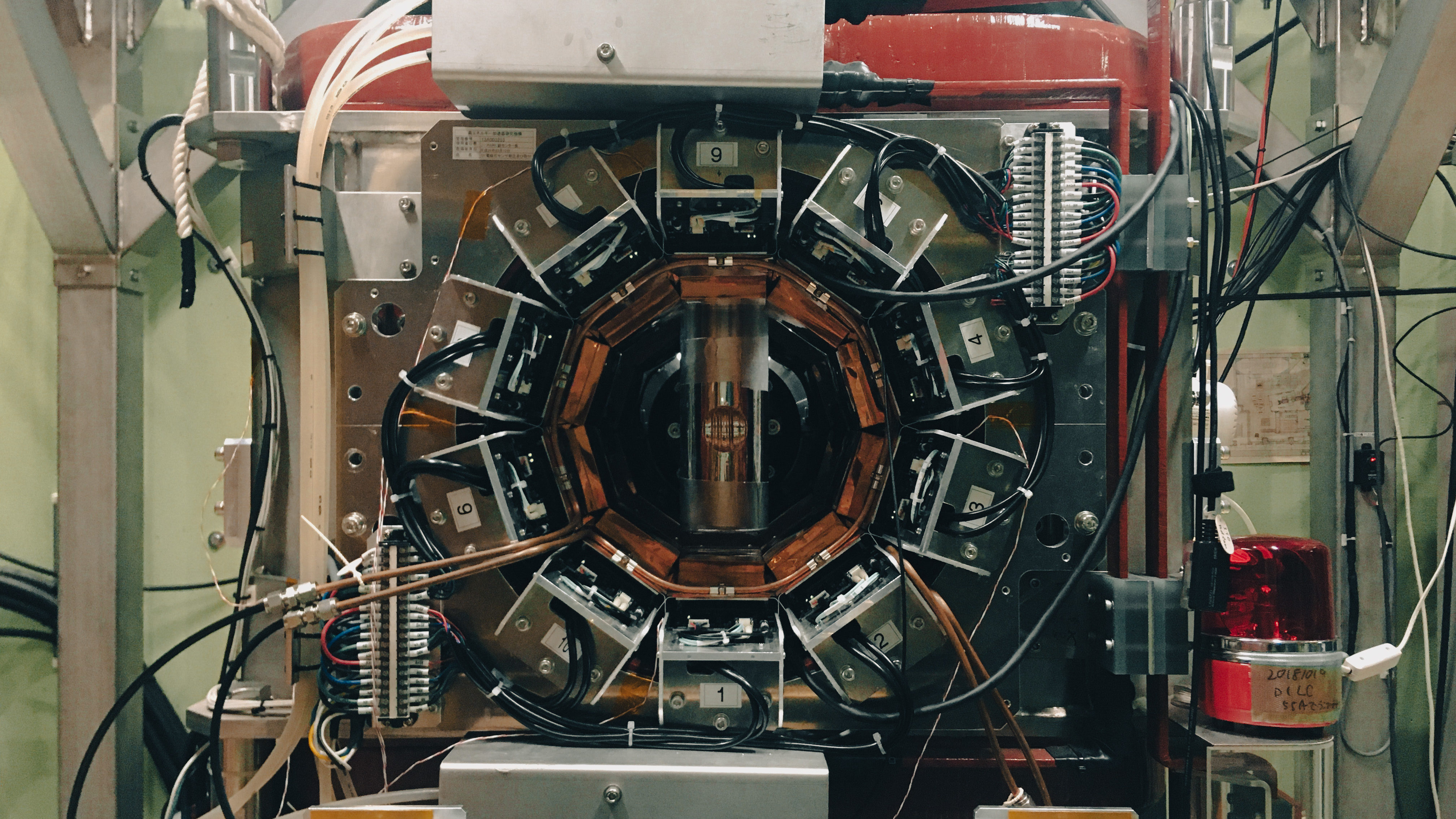
A μSR spectrometer combines a polarized muon beam, a sample environment, magnetic-field control, and fast positron detectors. The beam defines the initial spin direction and time zero. The sample is placed at the center of a detector array, often with forward/backward and up/down segmentation so that several polarization components can be reconstructed.

Modern pulsed-beam instruments must accept a very high instantaneous hit rate. At J-PARC, segmented plastic-scintillator arrays with SiPM readout and the KALLIOPE multi-hit electronics were developed for this purpose. A representative detector plane contains 24 × 24 scintillator tiles, and two-layer coincidence suppresses SiPM dark-noise backgrounds. [3]

分光器を構成する要素

μSR分光器は、偏極ミュオンビーム、試料環境、磁場制御、そして高速陽電子検出器から構成されます。 ビームが初期スピン方向とtime zeroを定義し、試料を検出器arrayの中心へ配置します。 前後・上下など複数方向に分割して検出することで、複数のスピン偏極成分を再構成できます。

パルスビーム用の現代的な分光器では非常に高い瞬間hit rateへの耐性が必要です。 J-PARCではこの目的のため、SiPM読み出しの高細分化plastic scintillatorとKALLIOPE multi-hit electronicsが 開発されました。代表的な検出面は24 × 24のscintillator tileからなり、二層coincidenceによって SiPM dark noiseを抑えます。

Field and sample environments

Rotation, relaxation, and resonance require different field conditions: transverse fields for precession, compensated near-zero fields for spontaneous magnetism, longitudinal fields for decoupling and dynamics studies, and oscillating fields for resonance. Temperature, pressure, electric fields, light irradiation, or current can be added according to the scientific question.

The experimentally measured quantity is always the same basic time spectrum of decay positrons. The versatility of μSR comes from changing the controlled perturbation and the sample environment while retaining a common spin-sensitive readout.

磁場・試料環境

rotation、relaxation、resonanceでは必要な磁場条件が異なります。歳差運動には横磁場、 自発磁性には補償したnear-zero field、decouplingやdynamic studyには縦磁場、 resonanceには交流磁場を用います。研究対象に応じて、温度、圧力、電場、光照射、電流なども加えられます。

どの場合でも直接測るのは崩壊陽電子の時間スペクトルです。同じspin-sensitive readoutを使いながら、 外場や試料環境を変えることで多様な物理量へアクセスできることがμSRの大きな特徴です。


Applications and Instrumentation / 応用と装置開発

From bulk μSR to depth-resolved spectroscopy

Conventional surface-muon μSR is exceptionally effective for bulk samples, but the 4 MeV implantation energy places most muons too deep for nanometer-scale films and interfaces. Low-energy beams solve this problem by controlling the implantation energy and therefore the mean stopping depth.

At the J-PARC MUSE U1A area, an ultra-slow-muon spectrometer has been developed for implantation energies from nearly zero to 30 keV. Commissioning demonstrated the beam and positron-detection performance required for depth-resolved μSR, and subsequent work has demonstrated measurements on multilayer thin-film samples. [8], [9]

バルクμSRから深度分解分光へ

surface muonを用いる従来μSRはバルク試料に非常に有効ですが、約4 MeVの注入エネルギーでは nmスケール薄膜や界面に対して停止位置が深すぎます。低エネルギービームを使えば、 注入エネルギーを変えることで平均停止深さを制御できます。

J-PARC MUSE U1Aでは、ほぼゼロから30 keVまで注入エネルギーを制御できる超低速ミュオン分光器を 開発しました。commissioningによって深度分解μSRに必要なビーム・陽電子検出性能を実証し、 その後、多層薄膜試料を用いたdepth-resolved measurementへ展開しています。

Adding information beyond decay time

Standard μSR detectors deliberately prioritize timing and solid angle over positron energy. We have also studied energy-resolved muon spin spectroscopy using a Cherenkov calorimeter. Adding energy information provides another handle on decay kinematics and detector response, and can open alternative analysis strategies for high-rate or background-limited experiments.

These instrumentation studies connect directly to other precision-muon experiments: segmented timing detectors, field control, beam-profile measurements, and calorimetry are shared technologies across μSR, muonium spectroscopy, muonic-atom spectroscopy, and precision lifetime measurements. [10]

崩壊時刻以外の情報も利用する

標準的なμSR検出器は、陽電子エネルギーよりもtimingとsolid angleを優先して設計します。 一方、Cherenkov calorimeterを用いて陽電子エネルギーも測るenergy-resolved muon spin spectroscopyも 研究しています。エネルギー情報を加えることで、崩壊kinematicsや検出器応答に新しい制約を与え、 high-rateあるいはbackground-limitedな測定で異なる解析方法を構築できます。

こうした装置研究は他の精密ミュオン実験にも直接つながります。高細分化timing detector、 磁場制御、ビームprofile測定、calorimetryは、μSR、muonium分光、ミュオン原子分光、 そして精密寿命測定に共通する基盤技術です。


References / 参考文献

  1. A. D. Hillier et al., “Muon spin spectroscopy,” Nature Reviews Methods Primers 2, 4 (2022).
  2. S. J. Blundell, R. De Renzi, T. Lancaster, and F. L. Pratt, Muon Spectroscopy: An Introduction, Oxford University Press (2021).
  3. K. M. Kojima et al., “New μSR spectrometer at J-PARC MUSE based on Kalliope detectors,” Journal of Physics: Conference Series 551, 012063 (2014).
  4. T. J. Jackson et al., “Depth-Resolved Profile of the Magnetic Field beneath the Surface of a Superconductor with a Few nm Resolution,” Physical Review Letters 84, 4958 (2000).
  5. M. Hiraishi et al., “Local electronic structure of dilute hydrogen in β-Ga2O3 probed by muons,” Physical Review B 107, L041201 (2023).
  6. V. W. Hughes et al., “Formation of Muonium and Observation of its Larmor Precession,” Physical Review Letters 5, 63 (1960).
  7. S. Kanda et al., “New precise spectroscopy of the hyperfine structure in muonium with a high-intensity pulsed muon beam,” Physics Letters B 815, 136154 (2021).
  8. S. Kanda et al., “Muon Spin Spectrometer at MLF MUSE U1A: Commissioning Results and Upgrade Plans,” JPS Conference Proceedings 45, 011044 (2026). doi:10.7566/JPSCP.45.011044
  9. S. Kanda et al., “Depth-Resolved μSR Using Ultra-Slow Muons at the J-PARC MUSE Facility,” Journal of Physics: Conference Series 3222, 012016 (2026). doi:10.1088/1742-6596/3222/1/012016
  10. Y. Ma, S. Kanda, S. Matoba, K. Tsukada, and P. Zhang, “Demonstration of energy-resolved muon spin spectroscopy using a Cherenkov calorimeter,” Nuclear Instruments and Methods in Physics Research A 1092, 171842 (2026). doi:10.1016/j.nima.2026.171842

Related Publications & Presentations / 関連論文・発表

Selected outputs related to μSR methods and detector/spectrometer development are listed below. / μSR手法および検出器・分光器開発に関係する主な成果をまとめます。

Publications / 論文

  • 2026
    Depth-Resolved μSR Using Ultra-Slow Muons at the J-PARC MUSE Facility
    S. Kanda et al. · Journal of Physics: Conference Series 3222, 012016
  • 2026
    Muon Spin Spectrometer at MLF MUSE U1A: Commissioning Results and Upgrade Plans
    S. Kanda et al. · JPS Conference Proceedings 45, 011044
  • 2026
    Demonstration of energy-resolved muon spin spectroscopy using a Cherenkov calorimeter
    Y. Ma, S. Kanda et al. · Nuclear Instruments and Methods in Physics Research A 1092, 171842
  • 2016
    Development of a new positron counting system with SiPM readout for muon spin spectrometers
    S. Kanda et al. · Proceedings of Science, PoS(PhotoDet2015)036

Selected presentations / 主な発表

  • 2024
    Muon Spin Spectrometer at MLF MUSE U1A: Commissioning Results and Upgrade Plans
    J-PARC2024 · Mito · October 2024
  • 2023
    Commissioning of the ultra-slow muon beamline towards practical use with thin-film samples
    MRM2023 · Kyoto · December 2023
  • 2022
    The Ultra-Slow Muon beamline at J-PARC: the present status and future prospects
    MuSR2020/22 · Parma · September 2022