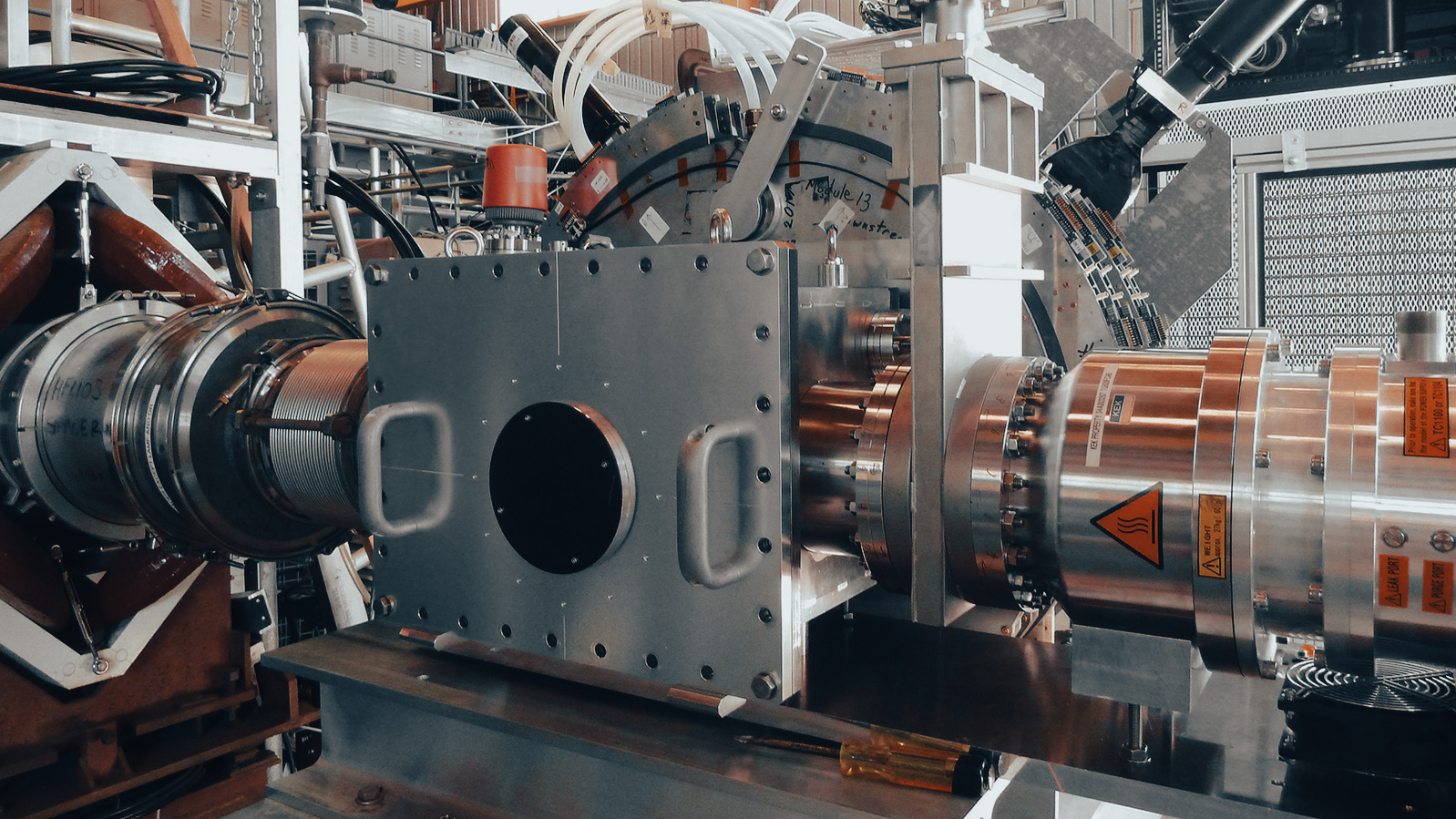
Muon Anomalous Magnetic Moment and Electric Dipole Moment

Muon g-2 and electric dipole moment experiment

Introduction / はじめに

Precision tests with a spinning muon

A charged particle with spin behaves like a tiny magnet. For a point-like spin-$1/2$ particle, the Dirac equation predicts a magnetic $g$ factor of 2. Quantum fluctuations slightly modify this value, and the difference is conventionally expressed as the anomalous magnetic moment

$$a_\mu=\frac{g_\mu-2}{2}.$$

Because the muon is much heavier than the electron, its magnetic moment is particularly sensitive to quantum effects involving heavier virtual particles. Precise measurements of $a_\mu$ therefore provide stringent tests of particle-physics calculations and a broad search for effects beyond the Standard Model.

回転するミュオンで素粒子論を検証する

スピンを持つ荷電粒子は小さな磁石のように振る舞います。点状のスピン$1/2$粒子に対して、 ディラック方程式は磁気$g$因子を2と予言しますが、量子揺らぎによってわずかな補正が生じます。 この差を異常磁気能率

$$a_\mu=\frac{g_\mu-2}{2}$$

と表します。ミュオンは電子よりはるかに重いため、より重い仮想粒子を含む量子効果にも高い感度を持ちます。 したがって $a_\mu$ の精密測定は、素粒子理論の厳密な検証と標準模型を超える効果の探索に利用されます。

Two dipole moments / 二つの双極子モーメント: The magnetic dipole moment is expected and is used to measure $g-2$. A permanent electric dipole moment would instead require violation of discrete symmetries and would be a qualitatively different signal of new physics. / 磁気双極子モーメントは通常の電磁相互作用で存在し、その精密なずれが $g-2$ です。 一方、永久電気双極子モーメントの存在は離散対称性の破れを意味し、質的に異なる新物理の信号になります。


Muon g−2 / ミュオン g−2

Measuring spin precession in a magnetic field

A relativistic muon moving in a magnetic field follows a curved orbit while its spin also precesses. The experimentally useful quantity is the spin-precession frequency relative to the orbital motion. In an idealized magnetic field this anomalous precession is proportional to $a_\mu B$.

The spin direction is read out through the parity-violating muon decay: high-energy decay positrons are emitted preferentially along the spin direction for positive muons. Recording the positron time distribution and direction while the muons circulate therefore reveals the spin-precession frequency. [1]

磁場中のスピン歳差運動を測る

相対論的なミュオンを磁場中で運動させると、軌道が曲げられると同時にスピンも歳差運動します。 実験では軌道運動に対するスピン歳差の相対周波数を測定します。理想化した磁場では、 この異常歳差周波数は $a_\mu B$ に比例します。

スピン方向はパリティを破るミュオン崩壊を利用して読み出します。正ミュオンでは高エネルギー陽電子が スピン方向に優先的に放出されるため、蓄積中の陽電子の時刻と方向を測定すると スピン歳差周波数を求めることができます。

Why use an independent experimental method?

A precision result is most powerful when it can be reproduced with substantially different systematic uncertainties. The J-PARC E34 concept was therefore designed not as a copy of the large storage-ring experiments, but as an independent approach using a much lower-emittance muon beam and a compact storage magnet.

The low-emittance beam reduces the need for strong focusing fields inside the storage region. This changes the balance of systematic effects and makes the J-PARC measurement complementary to previous storage-ring measurements. [1]

独立な実験手法を用いる意義

精密測定では、異なる系統誤差を持つ方法で結果を再現できることが重要です。 J-PARC E34は大型蓄積リング実験をそのまま再現するのではなく、低エミッタンスのミュオンビームと 小型の蓄積磁石を用いる独立な手法として設計されています。

低エミッタンスビームを用いることで蓄積領域内の強い収束場への依存を小さくでき、 系統誤差の構成も従来法とは異なります。このためJ-PARC測定は既存の蓄積リング測定と相補的です。


Muon EDM / ミュオン電気双極子モーメント

A different orientation of the spin motion

An electric dipole moment (EDM) associates the spin with a permanent separation of electric charge. For a fundamental particle, a nonzero permanent EDM violates parity and time-reversal symmetry and, under the usual assumptions of quantum field theory, also signals CP violation.

In a storage experiment, a magnetic moment mainly causes the spin to precess within the orbital plane. An EDM introduces an additional precession component that tips the spin out of that plane. The same decay-positron tracking used for $g-2$ can therefore search for a vertical time-dependent asymmetry. [1]

スピン運動の向きが変わる

電気双極子モーメント(EDM)は、スピン方向と永久的な電荷分布の偏りを結びつける物理量です。 素粒子に永久EDMが存在すれば、空間反転対称性と時間反転対称性が破れ、 通常の量子場理論の枠組みではCP対称性の破れも意味します。

蓄積リングを用いる実験では、磁気モーメントは主に軌道面内でスピンを歳差運動させます。 EDMが存在すると軌道面外へスピンを傾ける追加の歳差運動が生じます。 したがって $g-2$ と同じ崩壊陽電子の飛跡情報を用い、上下方向の時間依存非対称度を探索できます。

One apparatus, two observables / 一つの装置で二つの観測量: $g-2$ is primarily encoded in the horizontal spin precession, while an EDM would generate a vertical component. This is why the J-PARC experiment is designed to measure both quantities simultaneously with three-dimensional positron tracking. / $g-2$ は主に水平方向のスピン歳差に、EDMは鉛直方向の成分に現れます。 そのためE34では陽電子の三次元飛跡測定によって両者を同時に測る設計になっています。


J-PARC E34 Experiment / J-PARC E34実験

From surface muons to a low-emittance beam

The distinctive element of E34 is its beam preparation. Surface muons are stopped in a muonium-production target. Muonium atoms emitted into vacuum are resonantly ionized by lasers, producing thermal-energy positive muons with very small transverse emittance. The muons are then accelerated by a dedicated linac.

The design momentum is about 300 MeV/$c$, roughly an order of magnitude below the “magic-momentum” beam used in the traditional storage-ring method. [1], [2]

表面ミュオンから低エミッタンスビームへ

E34の最も特徴的な点はビーム生成法です。表面ミュオンをミュオニウム生成標的へ停止させ、 真空中へ放出されたミュオニウムをレーザーで共鳴イオン化します。これにより横方向のエミッタンスが非常に小さい 熱エネルギー正ミュオンを作り、その後専用の線形加速器で再加速します。

設計運動量は約300 MeV/$c$で、従来の蓄積リング法で用いられる「マジック運動量」より およそ一桁低い運動量です。

Compact storage magnet and positron tracker

The accelerated beam is injected into a compact, highly uniform storage magnet using a three-dimensional spiral injection scheme. Muons decay while circulating, and silicon-strip tracking detectors reconstruct the trajectories of the decay positrons.

The 2019 PTEP design paper quoted, as the design goals at that time, a statistical precision of 450 ppb for $a_\mu$, a systematic uncertainty below 70 ppb, and an EDM sensitivity of $1.5\times10^{-21}\,e\,{\rm cm}$. [1]

小型蓄積磁石と陽電子飛跡検出器

加速したビームは三次元らせん入射法によって、高い磁場一様性を持つ小型蓄積磁石へ入射します。 蓄積中にミュオンが崩壊し、シリコンストリップ飛跡検出器で陽電子の軌跡を三次元的に再構成します。

2019年のPTEP論文では、当時の設計目標として $a_\mu$ の統計精度450 ppb、系統誤差70 ppb未満、 EDM感度 $1.5\times10^{-21}\,e\,{\rm cm}$ が示されています。


Project Status / 実験計画の状況

Stepwise commissioning

E34 is being constructed and commissioned in stages. Important recent milestones include the first RF acceleration of positive muons to 100 keV, extension and commissioning of the H-line toward the H2 area, tests of the ultra-slow-muon diagnostic line, and beam tests of silicon-strip detector modules.

According to the J-PARC project status report published in April 2026, muonium was successfully generated, laser-ionized, and extracted in the H2 area by the end of 2025. The source was then being reconfigured for connection to the RF acceleration system, with further acceleration tests planned as the next commissioning step. [3]

段階的に進む立ち上げ試験

E34は複数の装置要素を段階的に建設し、立ち上げ試験を進めています。近年の主な進展には、 正ミュオンの100 keVまでの高周波(RF)加速、H-lineのH2エリアへの延伸とビーム試験、 超低速ミュオン診断ラインの試験、シリコンストリップ検出器モジュールのビーム試験などがあります。

2026年4月に公表されたJ-PARCの状況報告によれば、2025年末までにH2エリアでミュオニウムの生成、 レーザーイオン化、取り出しに成功しています。その後、RF加速系へ接続するためのミュオン源の再構成が進められ、 次の段階としてさらなる加速試験が計画されています。

Scope of this page / このページの位置づけ: This page provides a compact overview of the experiment and of my earlier related work rather than a detailed status report of each E34 subsystem. / このページではE34の各装置要素の最新状況を網羅するのではなく、実験の考え方と過去の関連研究を コンパクトに紹介しています。


Muonium Emitter / ミュオニウム生成標的

Producing muonium in vacuum

The low-emittance beam begins with an efficient source of muonium in vacuum. Positive muons are stopped in a porous material such as silica aerogel, where a fraction forms muonium and diffuses to the surface before the muon decays. Muonium emitted into vacuum can then be laser-ionized without inheriting the large phase-space spread of the original surface muon beam.

Improving vacuum emission therefore requires control of both muonium formation and diffusion. Surface microstructures, including laser-ablated channels in silica aerogel, were developed to shorten the diffusion distance and enhance the useful emission rate. [4], [5]

真空中へミュオニウムを取り出す

低エミッタンスビームの出発点は、真空中へ効率よくミュオニウムを放出する生成標的です。 正ミュオンをシリカエアロジェルのような多孔質材料へ停止させると、その一部がミュオニウムを形成し、 ミュオンが崩壊する前に表面まで拡散して真空中へ放出されます。これをレーザーイオン化すれば、 元の表面ミュオンビームが持つ大きな位相空間の広がりを引き継がない低速ミュオンを得られます。

真空放出効率の改善にはミュオニウム形成と拡散の両方を制御する必要があります。 シリカエアロゲル表面をレーザー加工して微細構造を形成し、表面までの拡散距離を短縮することで 有効な放出率を高める方法などが開発されました。

Earlier involvement

My earlier work in the J-PARC $g-2$/EDM program was mainly connected to this muonium-source concept and to detector development. The muonium-production target was also an important bridge to later work on slow-muon and muonium-beam technologies.

過去の関連研究

私がJ-PARC $g-2$/EDM計画で初期に関わった研究は、主にこのミュオニウム生成標的と 検出器開発に関連するものでした。ミュオニウム生成標的の研究は、その後の低速ミュオン・ ミュオニウムビーム技術にもつながる基盤となっています。


References / 参考文献

  1. M. Abe et al., “A new approach for measuring the muon anomalous magnetic moment and electric dipole moment,” Progress of Theoretical and Experimental Physics 2019, 053C02 (2019). doi:10.1093/ptep/ptz030
  2. S. Kanda, “Muonium production target for the muon g-2/EDM experiment at J-PARC,” Nuclear Physics B - Proceedings Supplements 253–255, 212–213 (2014). doi:10.1016/j.nuclphysbps.2014.09.054
  3. J-PARC Project Newsletter No. 102, “Status of the Muon g-2/Electric Dipole Moment (EDM) (E34),” April 2026. J-PARC status report
  4. G. A. Beer et al., “Enhancement of muonium emission rate from silica aerogel with a laser-ablated surface,” Progress of Theoretical and Experimental Physics 2014, 091C01 (2014).
  5. P. Bakule et al., “Measurement of muonium emission from silica aerogel,” Progress of Theoretical and Experimental Physics 2013, 103C01 (2013).
  6. R. Azuma et al., “Hit-rate capability of a silicon strip detector module for decay positron detection in the J-PARC muon g-2/EDM experiment,” Journal of Instrumentation 21, P07039 (2026). doi:10.1088/1748-0221/21/07/P07039

Related Publications & Presentations / 関連論文・発表

A small selection of outputs related to my earlier involvement is listed below. / 過去の関与に直接関係する成果を少数だけ示します。

Publications / 論文

  • 2019
    A new approach for measuring the muon anomalous magnetic moment and electric dipole moment
    M. Abe et al. · Progress of Theoretical and Experimental Physics 2019, 053C02
  • 2014
    Muonium production target for the muon g-2/EDM experiment at J-PARC
    S. Kanda · Nuclear Physics B - Proceedings Supplements 253–255, 212–213

Selected presentation / 主な発表

  • 2013
    Muonium production target for the muon g-2/EDM experiment at J-PARC
    PCPV2013 · Maharashtra · February 2013