Measurements of the Muon Lifetime

Segmented detector for precision muon lifetime measurements

Introduction / はじめに

A simple decay with fundamental significance

The muon is an unstable elementary particle that decays through the weak interaction. Its mean lifetime is about 2.2 μs: long enough to follow the decay experimentally, but short enough that a large number of decays can be accumulated in an accelerator experiment. For a positive muon, the dominant decay is $\mu^+\rightarrow e^+ + \nu_e + \bar{\nu}_\mu$.

Measuring the exponential decay time distribution with very high precision determines the strength of the charged-current weak interaction. The muon lifetime is therefore not only a property of the muon itself; it is one of the cleanest experimental inputs for the Fermi coupling constant $G_F$ and for precision tests of the electroweak Standard Model. [1], [2]

単純な崩壊から弱い相互作用を精密測定する

ミュオンは弱い相互作用によって崩壊する不安定な素粒子で、平均寿命は約2.2 μsです。 加速器実験で一つ一つの崩壊を時間測定できる程度には長く、同時に大量の崩壊事象を短時間で蓄積できる という、精密測定に適した時間スケールを持っています。正ミュオンの主な崩壊は $\mu^+\rightarrow e^+ + \nu_e + \bar{\nu}_\mu$ です。

崩壊時刻分布の指数関数を高精度で測ることで、荷電カレント弱相互作用の強さを決定できます。 したがってミュオン寿命は単なる粒子の性質ではなく、Fermi結合定数 $G_F$ を決め、 電弱標準模型を精密に検証するための基礎入力です。


Muon Lifetime / ミュオン寿命

From an exponential curve to the Fermi constant

For an ensemble of free positive muons, the number of surviving muons follows

$$N(t)=N_0\exp(-t/\tau_\mu).$$

In natural units, the decay rate is related to the Fermi constant approximately by

$$\frac{1}{\tau_\mu} =\frac{G_F^2m_\mu^5}{192\pi^3} \left(1+\Delta q\right),$$

where $\Delta q$ represents phase-space and higher-order radiative corrections. Because the theoretical corrections are accurately calculable, an improvement in $\tau_\mu$ directly improves the experimental determination of $G_F$. [1], [3]

指数関数からFermi結合定数へ

自由な正ミュオン集団の残存数は

$$N(t)=N_0\exp(-t/\tau_\mu)$$

に従います。自然単位系では、崩壊率は概略

$$\frac{1}{\tau_\mu} =\frac{G_F^2m_\mu^5}{192\pi^3} \left(1+\Delta q\right)$$

と書けます。$\Delta q$ は電子質量によるphase-space補正や高次の放射補正を含みます。 理論補正を高精度で計算できるため、$\tau_\mu$ の精度向上はそのまま $G_F$ の精度向上につながります。

The present benchmark: MuLan

The MuLan experiment at PSI obtained $\tau_{\mu^+}=2.1969803(21)_{\rm stat}(7)_{\rm syst}\,\mu{\rm s}$, corresponding to a relative precision of about 1 ppm. In that measurement, the statistical contribution was still dominant. The leading systematic effects included muon-spin rotation and detector-gain variations.

This motivates a next-generation experiment with much larger statistics, provided that the detector can withstand the correspondingly higher instantaneous rate. [1], [2]

現在の基準となるMuLan測定

PSIのMuLan実験では $\tau_{\mu^+}=2.1969803(21)_{\rm stat}(7)_{\rm syst}\,\mu{\rm s}$ が得られ、相対精度は約1 ppmに到達しました。この測定でも統計誤差の寄与が最大で、 主な系統誤差にはミュオンスピン回転と検出器gain変動が含まれていました。

したがって、さらに大きな統計を利用できれば原理的には精度を改善できます。ただしそのためには、 高い瞬間計数率を扱える検出器と、スピン・pileup・gain変動を制御する測定系が必要になります。

Positive and negative muons / 正負ミュオンの違い: A stopped positive muon essentially undergoes free decay, whereas a stopped negative muon can also be captured by a nucleus. For this reason, the positive-muon lifetime provides the cleaner route to $G_F$; negative-muon disappearance measurements instead contain valuable information on nuclear muon capture. / 停止した正ミュオンは基本的に自由崩壊しますが、負ミュオンには原子核捕獲が競合します。 そのため $G_F$ の決定には正ミュオン寿命が適しており、負ミュオンの消失率はむしろ核捕獲反応を調べる 重要な観測量になります。


High-Intensity Pulsed Muon Beam / 大強度パルスミュオン

Why a pulsed beam helps

A lifetime experiment needs a start time for the muon ensemble and a long decay-observation window. With a continuous beam, individual muon arrivals must be identified or the beam must be artificially chopped into accumulation and measurement periods. MuLan used an electrostatic kicker to create such a time structure.

J-PARC MLF MUSE provides an intrinsically pulsed muon beam. Many muons arrive within a short bunch, and their subsequent decays can be recorded over the following microseconds. This is statistically efficient because the accelerator defines the common start time. The price is an extremely high instantaneous positron rate immediately after the pulse. [2]

パルスビームを使う利点

寿命測定には、ミュオン集団の開始時刻と、その後の十分に長い崩壊観測時間が必要です。 連続ビームでは個々のミュオン到達を検出するか、MuLanのように電場kickerで蓄積時間と測定時間を 人工的に分ける必要があります。

J-PARC MLF MUSEでは、ビーム自体がパルス化されています。短い時間幅の中に多数のミュオンが到達し、 その後数μsにわたる崩壊を測定できます。加速器タイミングが共通のstart timeになるため統計効率が高い一方、 パルス直後には極めて高い瞬間陽電子計数率が発生します。

The J-PARC proposal

The 2021 proposal study assumed the high-intensity H-Line beam and estimated that a detector covering 80% of $4\pi$ could collect $1.6\times10^{14}$ decay positrons in 23 days, roughly one hundred times the MuLan statistics. The study therefore targeted an order-of-magnitude improvement in the experimental determination of $G_F$.

These numbers are design assumptions of the proposal rather than a completed lifetime measurement. Their importance is to show where the limiting problem moves: once statistics become very large, pileup and time-dependent detector response become the central experimental challenge. [2]

J-PARCでの提案

2021年の提案研究では、大強度H-Lineビームと $4\pi$ の80%を覆う検出器を仮定し、 23日間で $1.6\times10^{14}$ 個の崩壊陽電子、すなわちMuLanのおよそ100倍の統計を 得られると見積もりました。この統計を利用して、$G_F$ の実験精度を一桁改善することを目標としました。

これらは完成した寿命測定の実測値ではなく、proposalで用いた設計上の仮定です。 重要なのは、大統計化によってボトルネックが統計誤差からpulse pileupや時間依存の検出器応答へ 移ることを定量的に示した点です。


Segmented Detector / 高細分化検出器

Segmenting the rate, not the physics

The dominant detector problem in an intense pulsed-beam experiment is double-pulse pileup: two positrons entering the same detector element within its pulse-pair resolution can be reconstructed as one hit. Because the event rate changes rapidly with time after the muon pulse, this loss distorts the exponential spectrum and can bias the fitted lifetime.

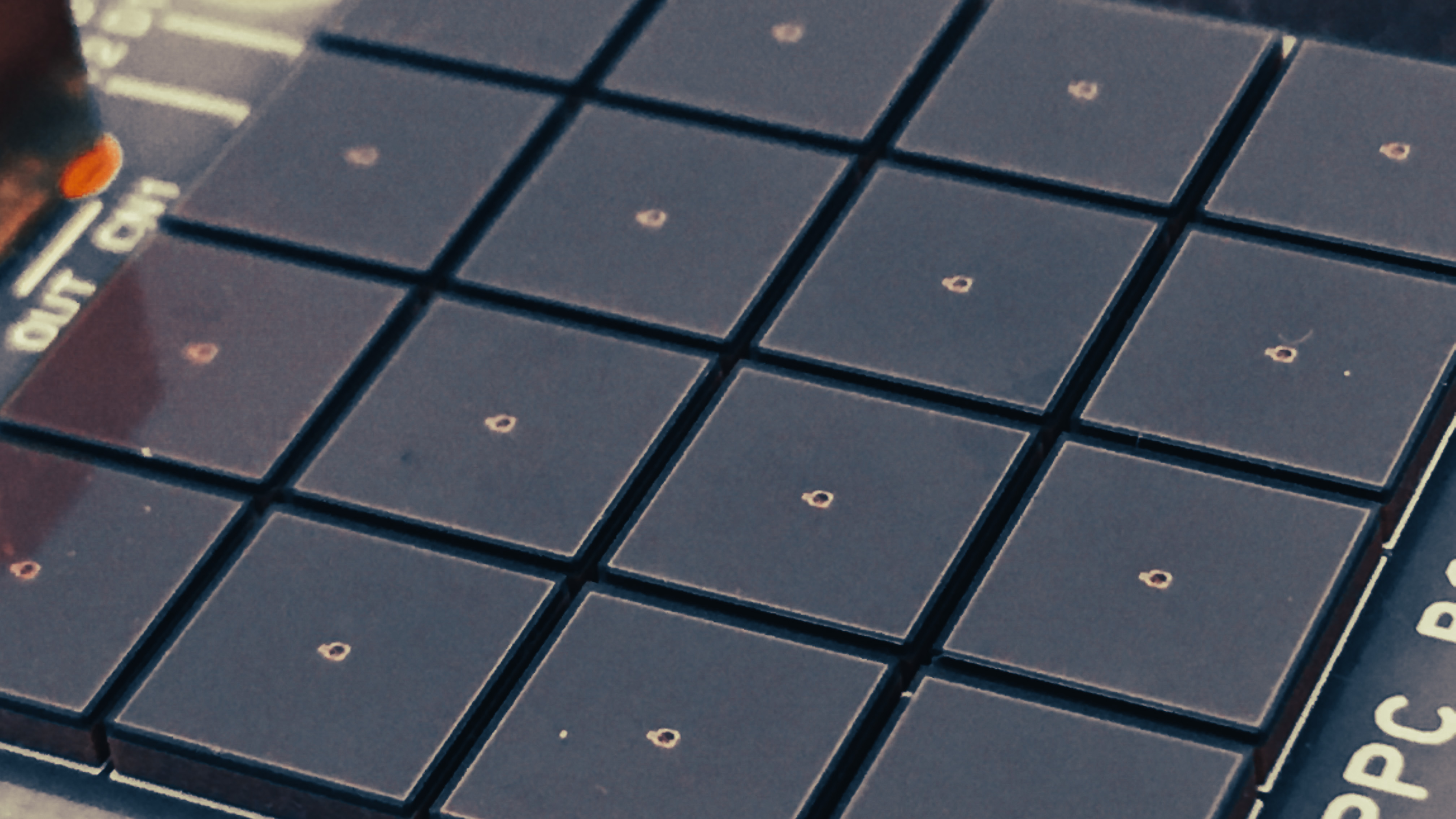
The proposed solution is extreme segmentation. The conceptual detector contains about 14,000 plastic-scintillator tiles, each approximately 3 mm × 3 mm, arranged around the stopping target on a sphere of about 10 cm radius and read out with SiPMs. Segmentation distributes the total rate over many independent channels and therefore reduces the probability of unresolved double hits. [2]

総計数率を多数のチャンネルへ分散する

大強度パルスビームで最大の検出器課題になるのがdouble-pulse pileupです。 検出器の二事象分離時間より短い間隔で同じ素子に二つの陽電子が入ると、一事象として数えられることがあります。 計数率はミュオンパルス直後から急激に時間変化するため、このlossは単なる効率低下ではなく、 指数関数スペクトルの形を歪めて寿命fitにbiasを与えます。

提案している解決方法は徹底した高細分化です。概念設計では約14,000個の 3 mm × 3 mm程度のプラスチックシンチレータを、停止標的から約10 cmの球面上に配置し、 SiPMで読み出します。総計数率を多数の独立チャンネルへ分散することで、未分離二重hitの確率を下げます。

A detector technology shared with μSR and precision spectroscopy

Highly segmented scintillator–SiPM detectors were originally developed at J-PARC to exploit intense pulsed muon beams in μSR and muonium spectroscopy. A representative KALLIOPE detector uses a 24 × 24 array of 10 mm × 10 mm × 3 mm scintillator tiles with fast multi-hit TDC readout. The lifetime proposal extends the same design philosophy to much finer segmentation.

This is a recurring theme in our instrumentation program: the same high-rate detector technologies developed for muon spin spectroscopy can be transferred to fundamental-physics measurements in which precise decay-time information is the signal. [4], [5]

μSR・精密分光と共通する検出器技術

高細分化scintillator–SiPM検出器は、J-PARCの大強度パルスミュオンをμSRやミュオニウム分光で 利用するために発展してきました。代表的なKALLIOPE検出器では、10 mm × 10 mm × 3 mmの scintillatorを24 × 24に並べ、multi-hit TDCで高速に読み出します。寿命測定の提案は、 この設計思想をさらに細かなsegmentationへ拡張したものです。

これは私たちの検出器開発に共通する考え方でもあります。ミュオンスピン分光のために開発した high-rate detector技術を、崩壊時刻そのものが信号となる基礎物理測定へ展開できます。


Experimental Setup / 実験装置

Stop, wait, and count

The experimental concept is deliberately simple. A pulsed surface-muon beam is stopped in a thin solid target. A nearly spherical segmented detector surrounding the target records the emission time and direction of decay positrons. The lifetime is extracted from the time spectrum accumulated over many beam pulses.

Simplicity of the principle does not imply simplicity of the precision experiment. The detector efficiency and timing response must remain stable over the entire decay window, and the reconstruction must correctly model unresolved hits, accidental coincidences, and any time-dependent threshold or gain effect. [2]

止めて、待って、崩壊を数える

実験原理そのものは非常に単純です。パルス表面ミュオンを薄い固体標的に停止させ、 周囲をほぼ球状に覆う高細分化検出器で崩壊陽電子の放出時刻と方向を記録します。 多数のビームパルスを積算した時間スペクトルから寿命を求めます。

しかし原理が単純でも、精密測定は単純ではありません。崩壊観測窓全体にわたり検出効率とtiming応答を 安定に保ち、未分離hit、偶発事象、thresholdやgainの時間変化を正確にmodelingする必要があります。

Suppressing muon-spin rotation

The positron angular distribution is correlated with the muon spin. Consequently, even a small residual magnetic field can rotate the spin and superimpose an oscillating component on the decay spectrum if the detector acceptance is not perfectly symmetric. This was already a leading systematic issue in MuLan.

The J-PARC concept therefore surrounds the target and detector with a magnetic shield and aims for a near-zero-field stopping region. A shield developed for MuSEUM demonstrated a residual field below about 100 nT over the relevant volume, providing an experimental basis for controlling this effect. [2]

ミュオンスピン回転を抑える

崩壊陽電子の角度分布はミュオンスピンと相関しています。そのため残留磁場があるとスピンが歳差運動し、 検出器acceptanceが完全に対称でない場合には、寿命スペクトルへ振動成分が重なります。 MuLanでもこの効果は主要な系統誤差の一つでした。

そこでJ-PARCの概念設計では標的・検出器の周囲を磁気shieldで囲み、停止領域をnear-zero fieldにします。 MuSEUM用に開発したshieldでは、必要な体積内で約100 nT以下の残留磁場が実証されており、 この系統誤差を抑えるための技術的基盤があります。


Feasibility Study and Results / 実現可能性評価と結果

What has been demonstrated

The published study is a proposal and detector-development paper, not a new measurement of the muon lifetime. Its principal result is a quantitative feasibility argument: the pulsed-beam statistics available at J-PARC could greatly exceed the MuLan sample, while segmentation can reduce the per-channel pileup to a tractable level.

The study also evaluated the residual-field requirement. A Monte Carlo estimate found that the μSR-related lifetime bias expected for a residual field of about 100 nT is negligible compared with the targeted sub-ppm statistical uncertainty. The remaining central detector problem is a precise description and experimental validation of pulse pileup. [2]

何が示されているか

公表済みの研究は、新しいミュオン寿命値を報告したものではなく、proposalおよび検出器開発研究です。 主な成果は定量的なfeasibility評価で、J-PARCのパルスビームを用いればMuLanを大きく上回る統計が 原理的に得られ、高細分化によって1チャンネル当たりのpileupを制御可能な領域へ下げられることを示しました。

また残留磁場の要件も評価し、約100 nTの磁場に由来するμSR効果は、目標とするsub-ppm統計誤差に比べて 無視できるとMonte Carloで見積もられています。一方、pulse pileupを十分な精度でmodelingし、 実機で検証することが今後の中心的な検出器課題です。

Research direction / 研究の位置づけ: The lifetime project connects two strands of our work: precision tests of fundamental muon properties and high-rate detector technologies developed for pulsed-beam μSR and spectroscopy. / この寿命測定は、ミュオンの基礎物理量の精密測定と、パルスμSR・分光のために培った high-rate detector技術を直接つなぐ研究テーマです。


References / 参考文献

  1. V. Tishchenko et al. (MuLan Collaboration), “Detailed report of the MuLan measurement of the positive muon lifetime and determination of the Fermi constant,” Physical Review D 87, 052003 (2013). doi:10.1103/PhysRevD.87.052003
  2. S. Kanda, “Toward a high-precision measurement of the muon lifetime with an intense pulsed muon beam at J-PARC,” Proceedings of Science, PoS(NuFACT2021)215 (2022). doi:10.22323/1.402.0215
  3. T. van Ritbergen and R. G. Stuart, “On the precise determination of the Fermi coupling constant from the muon lifetime,” Nuclear Physics B 564, 343–390 (2000).
  4. K. M. Kojima et al., “New μSR spectrometer at J-PARC MUSE based on Kalliope detectors,” Journal of Physics: Conference Series 551, 012063 (2014).
  5. S. Kanda et al., “Development of a new positron counting system with SiPM readout for muon spin spectrometers,” Proceedings of Science, PoS(PhotoDet2015)036 (2016).

Related Publications & Presentations / 関連論文・発表

Selected outputs directly related to the lifetime measurement and its detector technologies are listed below. / ミュオン寿命測定および関連する検出器技術の主な成果をまとめます。

Publications / 論文

  • 2022
    Toward a high-precision measurement of the muon lifetime with an intense pulsed muon beam at J-PARC
    S. Kanda · Proceedings of Science, PoS(NuFACT2021)215
  • 2016
    Development of a new positron counting system with SiPM readout for muon spin spectrometers
    S. Kanda et al. · Proceedings of Science, PoS(PhotoDet2015)036

Selected presentations / 主な発表

  • 2021
    Toward a high-precision measurement of the muon lifetime with an intense pulsed muon beam at J-PARC
    NuFACT2021 · Cagliari / Online · September 2021
  • 2020
    Development study toward the most precise measurement of the muon lifetime
    JPS 2020 Autumn Meeting · Online · September 2020