Research
Understanding the Beam to Improve the Machine
High-power accelerator physics connects microscopic mechanisms to measured signals, precise machine settings, and reliable operation.
A common thread
From Mechanism to Operation
My research follows a closed loop: identify the physical mechanism, build a model constrained by measurements, test it in beam studies, and turn the result into a reproducible operating method. The same loop connects beam-loss mitigation, phase-space reconstruction, 60 mA commissioning, and sequential inference.
Inside the J-PARC Linac
A Machine Longer Than the Screen
From the low-energy front end to the DTL, SDTL, ACS, and L3BT, each section shapes a different part of the same beam. Scroll horizontally to follow the accelerator downstream.

01 · Long-term beam-loss mitigation
Higher Power, Lower Residual Dose
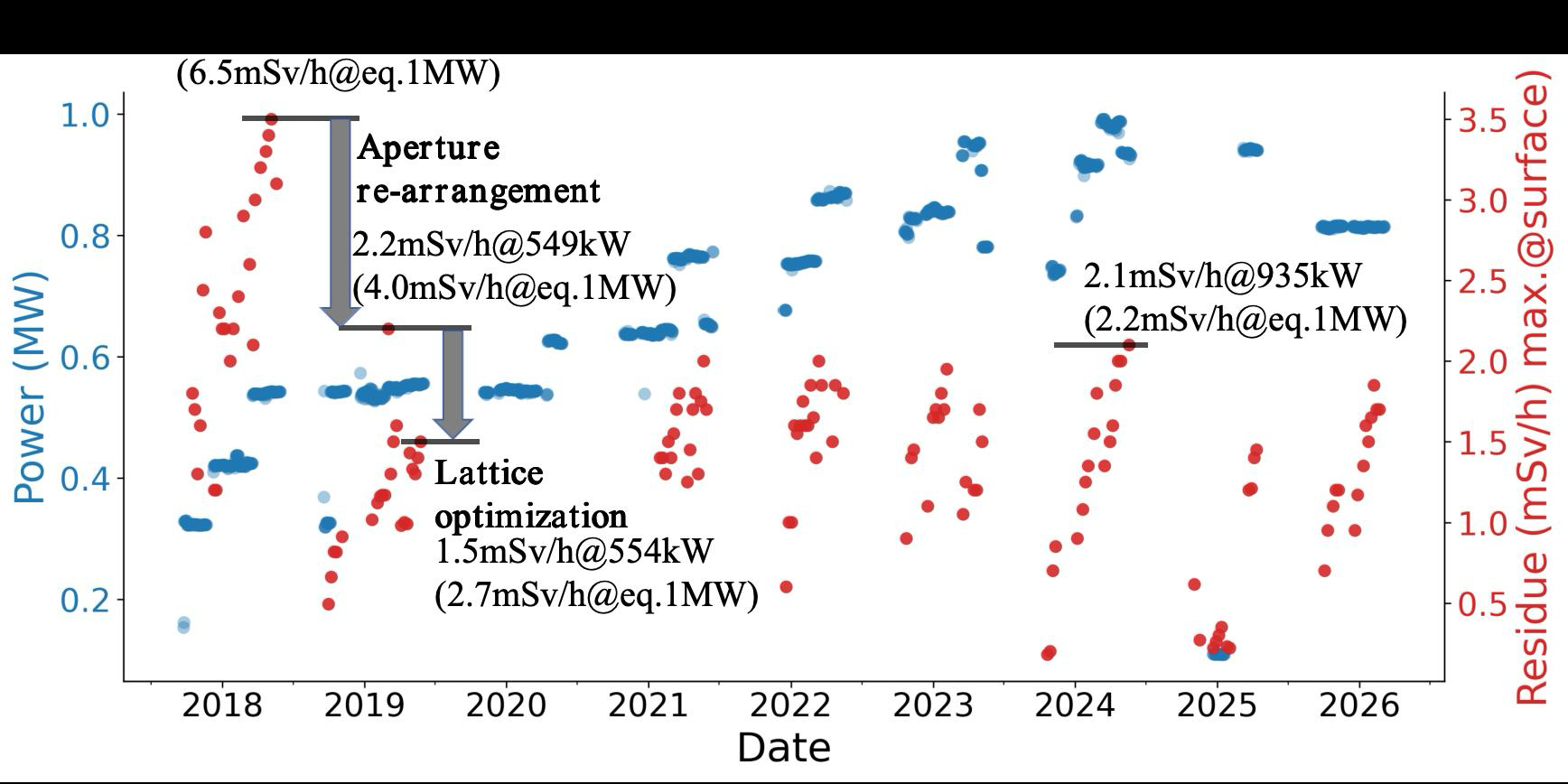
Aperture improvements removed local bottlenecks, while lattice optimization reduced the distributed stripping source. Together, these changes converted beam-loss physics into sustained operational improvement.
Across long-term operation, the maximum 1 MW-equivalent residual surface dose decreased from about 6.5 to 2.2 mSv/h—roughly one third of the earlier level—even as beam power increased.
Scientific significance. Joint optimization of global beam physics and local engineering delivers better maintainability and greater operating margin for power upgrades.
02 · Phase-space control
“Beam Temperature” Becomes a Machine Knob
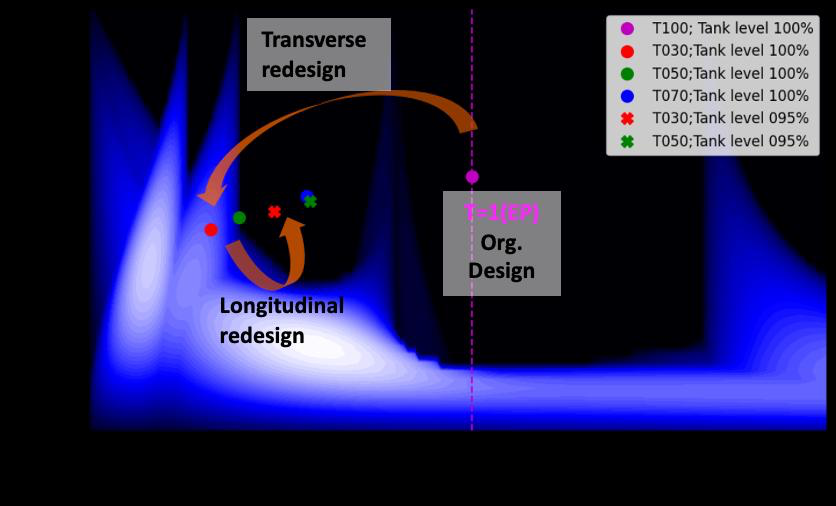
Particles in the bunch move differently in the transverse and longitudinal directions. Their effective temperature ratio is a practical control variable that focusing magnets and RF fields can redistribute.
We used measured phase space to explore candidate lattice settings, then compared the predicted stripping trend with beam-loss monitors. Relative to the reported reference setting, the measured loss fell by 26% at T=0.5 and 34% at T=0.3 under the test conditions; simulation gave closely corresponding reductions.
Scientific significance. A many-particle interaction becomes a controllable design and commissioning parameter.
03 · Intra-beam stripping
Tracking Beam Loss Across the Linac
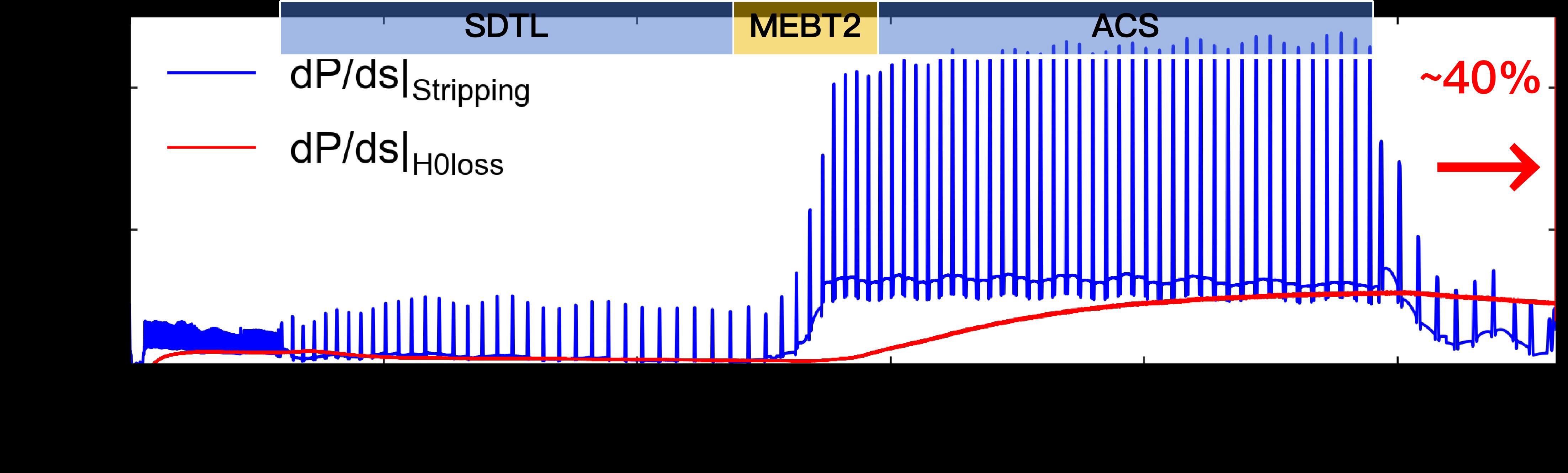
An H⁻ ion carries two electrons. When interactions within a dense bunch strip them away, the remaining H⁰ atom becomes electrically neutral and moves beyond quadrupole steering.
This creates a nonlocal problem: the stripping source can be upstream, while the radiation hotspot appears tens of metres later. Virtual-Aperture Ray Tracing reduces the calculation to the first geometric impact and makes full-linac loss localization practical.
Scientific significance. A loss monitor identifies the impact point; the model connects that signal to its upstream source. This source-to-impact picture strengthens diagnosis, aperture design, and radiation control.
04 · DTL beam-loss elimination
A Local Correction Removes a Radiation Hotspot
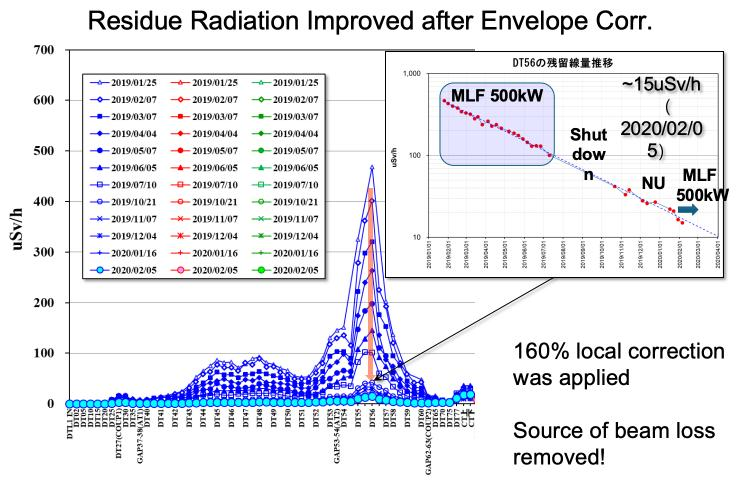
Residual-dose surveys revealed a sharp hotspot around DT56. Beam-envelope analysis focused the diagnosis on a local mismatch, and a 160% local correction reshaped the beam through the affected DTL section.
The correction removed the loss source. Successive surveys tracked the residual dose down to about 15 µSv/h in the reported 500 kW period.
Scientific significance. The result closes a complete operational loop: localize the radiation signature, identify the beam-dynamics mechanism, apply a targeted optics correction, and verify the improvement with repeated measurements.
05 · 60 mA commissioning
Delivering More Current with Beam Quality Intact
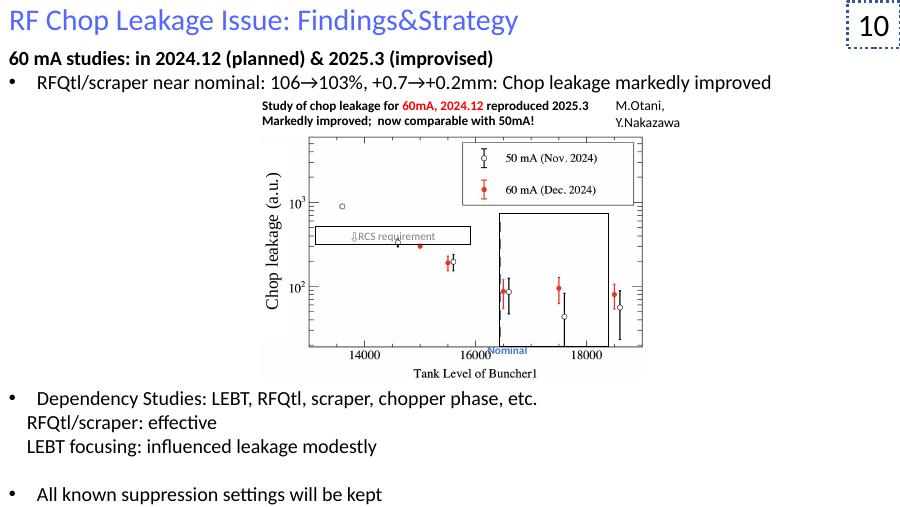
Raising current intensifies space charge, halo, chopping leakage, and emittance growth. The goal is a 60 mA beam with the quality required by the downstream machines.
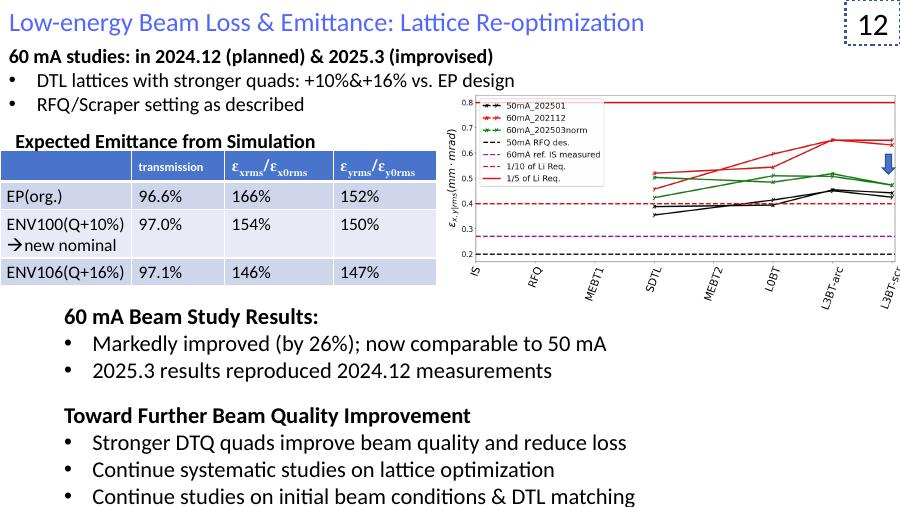
Studies of the RFQ, scraper, chopper, initial conditions, and DTL focusing produced repeatable improvement. Stronger DTL focusing reduced measured transverse emittance by 26%, bringing it close to the 50 mA operating level. Chopping studies also identified settings compatible with the RCS injection requirement.
Scientific significance. Physical understanding and precise lattice control deliver higher current efficiently and complement targeted hardware upgrades.
60 mA milestone. The beam studies provide an experimentally tested foundation for the J-PARC linac's 1.5 MW upgrade path.
06 · Structured inference
Structure Turns Sparse Data into a Machine-Wide Correction
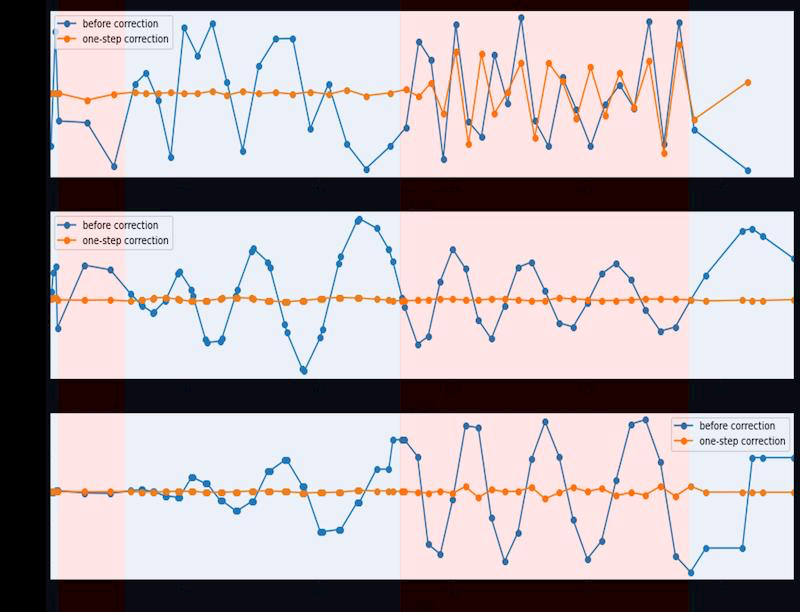
A large accelerator is an ordered causal sequence. Each cavity acts on the beam passed to the next element, so upstream errors accumulate into downstream observations. A static multilayer network captured the forward mapping; an encoder-decoder sequence model added the structure needed to reconstruct distributed errors.
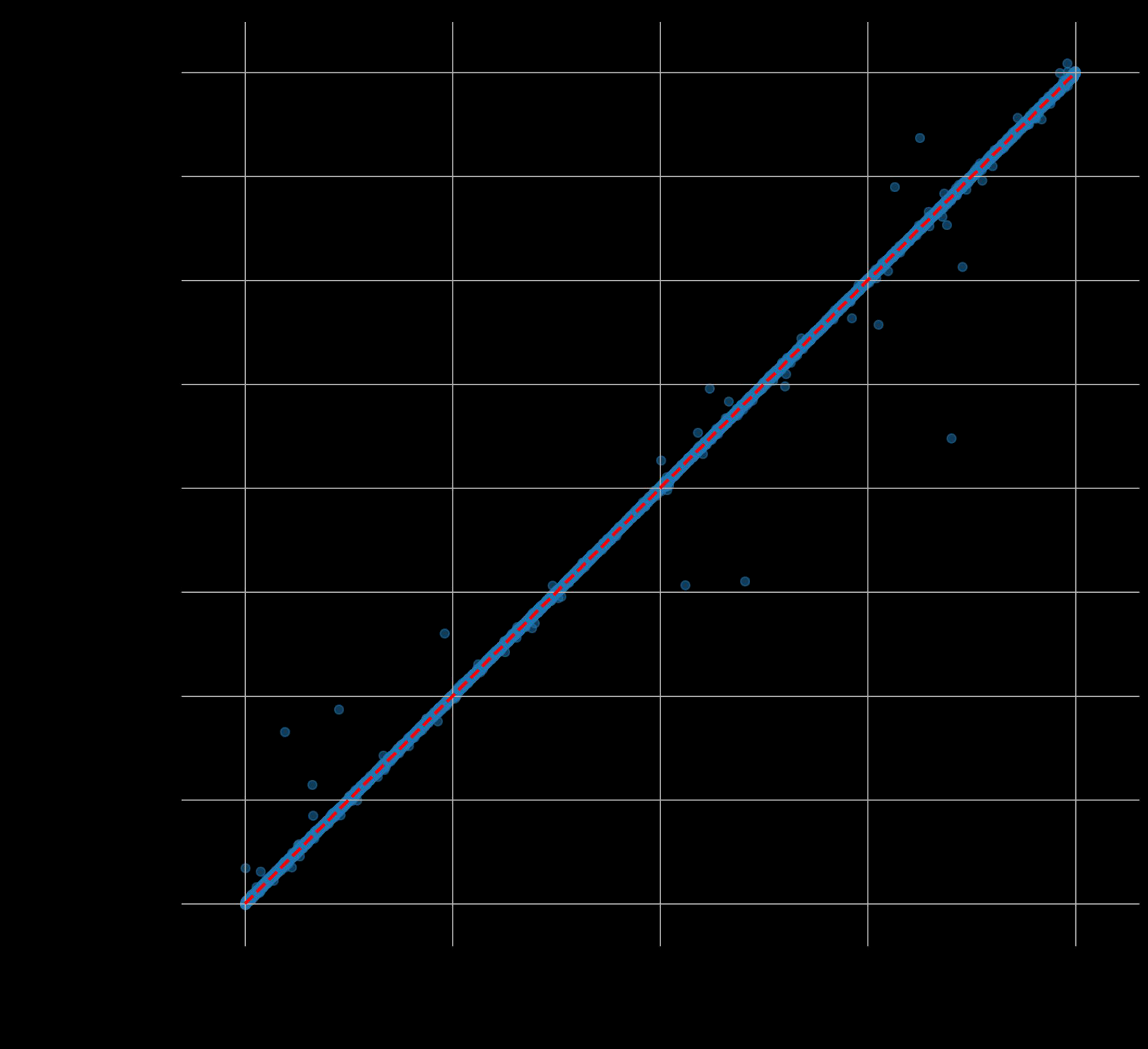
In realistic high-fidelity simulation, the sequence model recovered the 46-cavity error state from 87 monitoring points and enabled a global compensation calculation.
Scientific significance. Physics-guided machine learning gains power when the model architecture mirrors the physical system's causal structure.
Simulation milestone. High-fidelity simulation validates the method. Measurement calibration and online closed-loop deployment form the next stage.
Earlier work · HIRFL-CSR
Learning the Whole Accelerator Lifecycle
Earlier work at the Institute of Modern Physics, Chinese Academy of Sciences, covered the HIRFL-CSR heavy-ion storage-ring complex from design and construction to commissioning, acceptance, and machine studies. That experience established the system-level perspective that now connects physics models with operating reality at J-PARC.