
Accelerator physics · High-intensity proton linacs

Yong Liu

Associate Professor

Accelerator Laboratory, Inter-University Research Institute Corporation High Energy Accelerator Research Organization (KEK)
J-PARC Center

I work to make powerful accelerators understandable, controllable, and reliable—by following the beam from its microscopic physics to the way a kilometer-scale machine behaves.

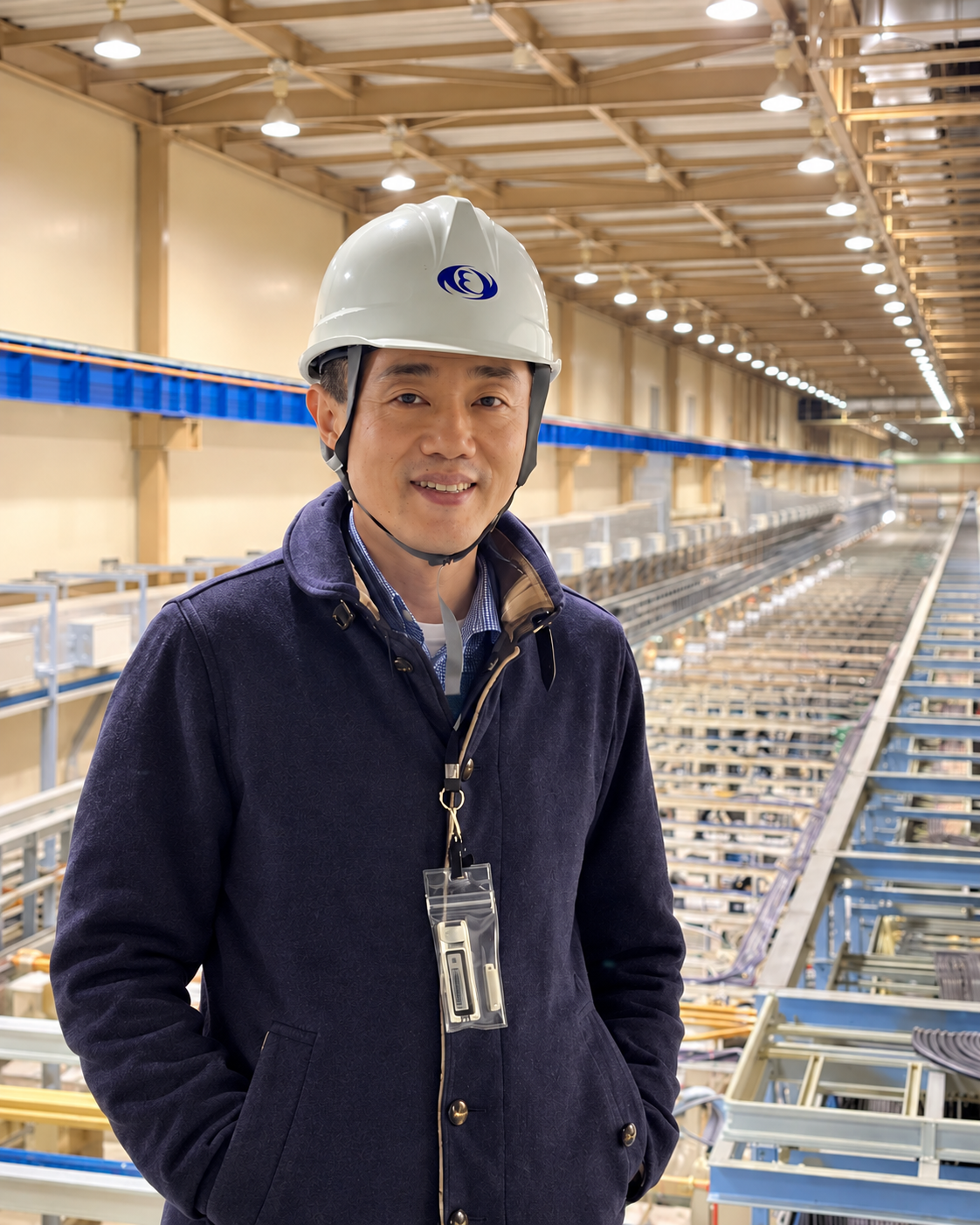
Yong Liu beside the J-PARC accelerator
At J-PARC, Tokai, Japan
Panoramic view of the J-PARC Linac from the front end through DTL, SDTL, ACS and L3BT
J-PARC Linac · from the front end through DTL, SDTL, ACS and L3BT · select for the scrollable view

About

From Accelerator Design to Sustained Operation

I am an accelerator physicist at KEK. My work spans the full life of a large scientific machine: design, construction, commissioning, diagnosis, improvement, and long-term operation. Earlier work at the HIRFL-CSR heavy-ion storage-ring complex gave me this system-wide view; at J-PARC, I apply it to one of the world's leading high-intensity proton accelerator facilities.

The goal is clear and ambitious: carry more beam while keeping loss, activation, and uncertainty firmly controlled. I combine beam dynamics, experiments, simulation, machine measurements, and structured inference to turn that goal into settings an operating team can use.

Long-term purpose

Accelerators as Engines of Discovery

My long-term goal is to make charged-particle accelerators more intense, precise, dependable, and easier to understand—so they can serve research across:

  • 01Matter and MaterialsProbing structure, dynamics, and function
  • 02Life SciencePowerful beams for biological and medical research
  • 03Future EnergyNew energy systems and accelerator-driven applications
  • 04High-Energy and Nuclear PhysicsTesting matter under extreme conditions
  • 05Particles and the UniverseFrom elementary particles to cosmic origins

Research stories

What the Beam Taught Us

Full Research Overview
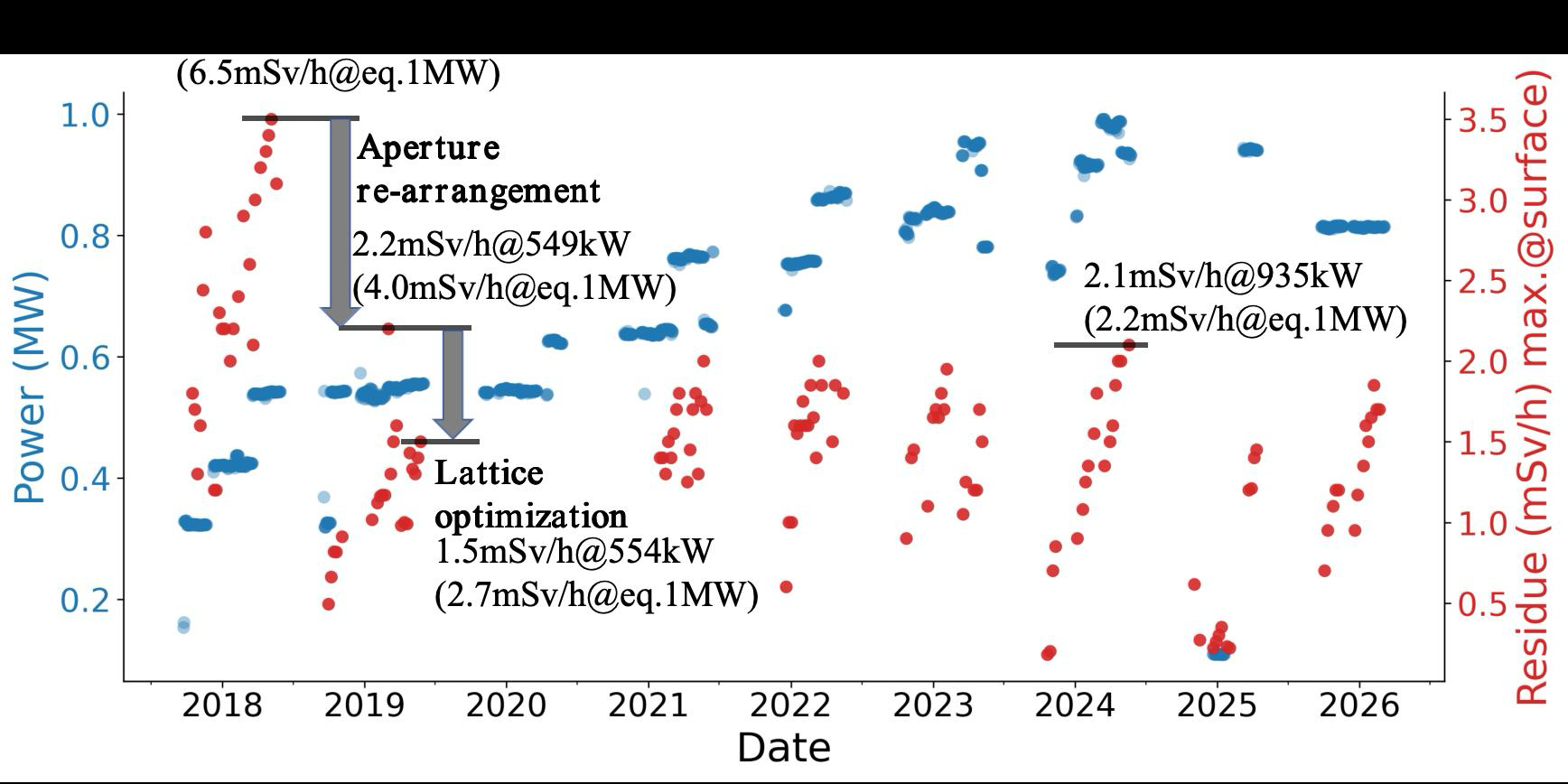
J-PARC linac beam power and maximum residual surface dose from 2018 to 2026
Power rose while aperture and lattice improvements reduced the 1 MW-equivalent maximum residual surface dose.

01 · Long-term beam-loss mitigation

Higher Power, Lower Residual Dose

Aperture improvements removed local bottlenecks, while lattice optimization reduced the distributed source. Across sustained operation, the maximum 1 MW-equivalent residual surface dose fell from about 6.5 to 2.2 mSv/h as beam power advanced.

This is beam physics translated into safer access, easier maintenance, and greater operating margin for the next stage of power upgrades.
LINAC 2026 invited talk

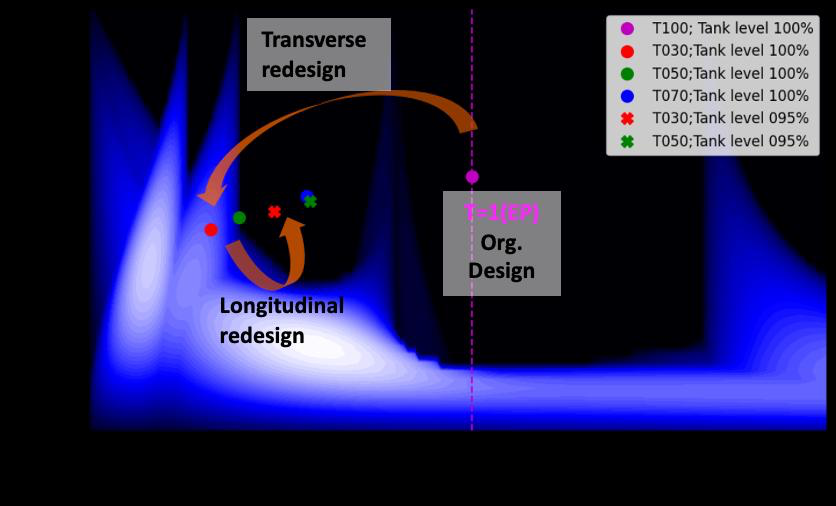
Beam-dynamics stability map used to select transverse and longitudinal temperature ratios
The Tune map connects transverse–longitudinal temperature ratios to stable, lower-loss operating points.

02 · A controllable knob

Turning Invisible Beam Physics into an Operating Setting

Intra-beam stripping grows when particles crowd one another. We turned this interaction into a controllable variable by redistributing the beam's transverse and longitudinal “temperature” through the focusing lattice.

The machine measurements followed the model: candidate settings reduced the observed loss by 26% and 34% under the reported test conditions. The wider achievement is a repeatable bridge from phase-space physics to an operational knob.

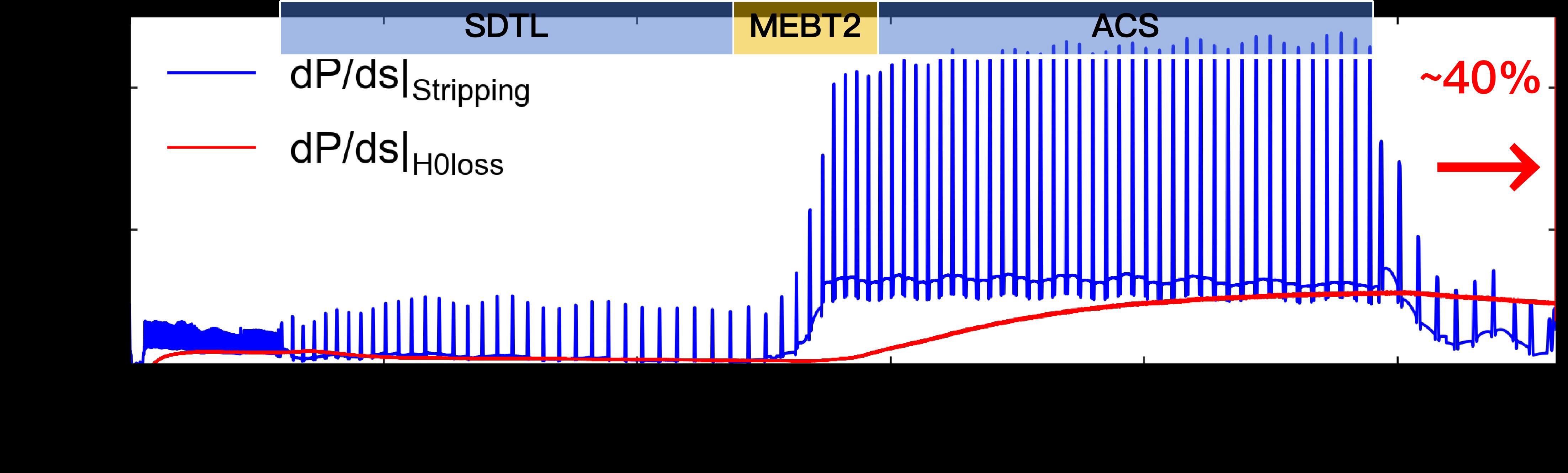
Calculated stripping source and downstream neutral hydrogen loss along the J-PARC linac
Blue: where H⁻ ions are stripped. Red: where the resulting H⁰ particles reach their first impact.

03 · Distributed beam loss

Tracing Beam Loss from Origin to Impact

When an H⁻ ion loses its electrons, it becomes neutral H⁰ and travels beyond magnetic steering. It can continue for tens of metres before reaching the beam pipe, connecting an upstream stripping event to a downstream radiation signal.

Transport calculations showed that, under the studied conditions, more than 40% of the relevant H⁰ trajectories could reach a dedicated downstream collection point. This source-to-impact picture guides aperture design, loss-monitor interpretation, and next-generation high-power H⁻ linacs.

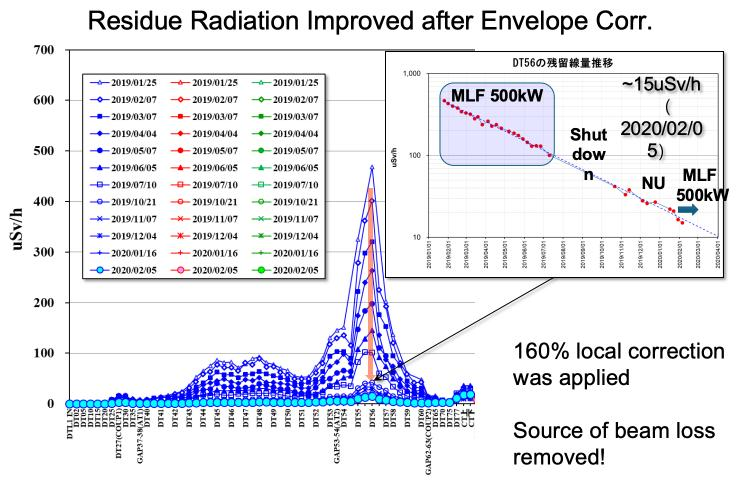
Measured DTL residual radiation before and after a local beam-envelope correction
A 160% local envelope correction removed the DT56 loss source; successive surveys tracked the residual-dose reduction.

04 · DTL beam-loss elimination

One Local Correction Removed a Radiation Hotspot

Residual-dose surveys revealed a sharp hotspot around DT56. Beam-envelope analysis identified a local mismatch, and a 160% correction reshaped the beam through the affected section and removed the loss source.

Successive surveys tracked the residual dose down to about 15 µSv/h in the reported 500 kW period. The result closes the loop from diagnosis, to optics correction, to radiation measurement.

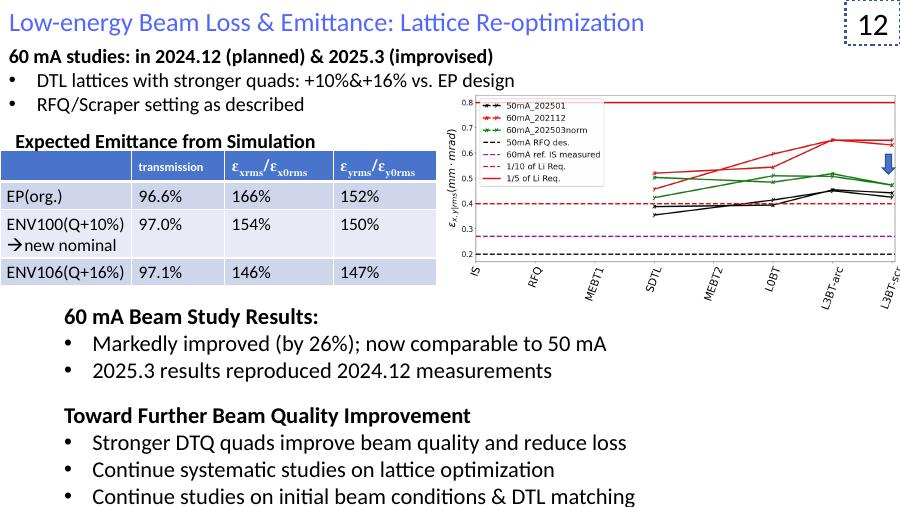
Simulation and measurement summary for 60 mA beam emittance after DTL lattice re-optimization
Re-optimized DTL focusing improved transverse emittance by 26%, approaching the 50 mA level.

05 · Toward the next power stage

More Current, Beam Quality Preserved

The goal is higher current with beam quality preserved throughout the accelerator. In repeated 60 mA studies, re-optimizing the DTL focusing improved transverse emittance by 26%, bringing beam quality close to the 50 mA operating level.

These 60 mA beam studies provide an experimentally tested foundation for the J-PARC linac's 1.5 MW upgrade path.

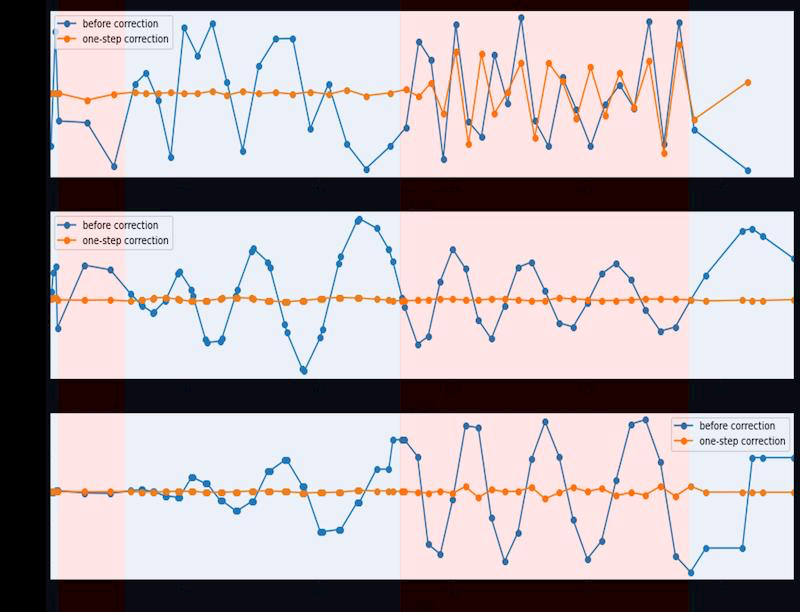
Distributed cavity phase, beam phase, and energy errors before and after one-step global correction
Blue: distributed errors before correction. Orange: the inferred one-step global correction.

06 · Structured inference

Sparse Monitors Reveal the Hidden Machine State

The J-PARC linac has 46 independently controlled RF cavities and 87 phase-monitoring points. A conventional static network captured the forward response; the decisive advance came from representing the accelerator's ordered structure.

The sequence model recovered distributed RF errors and constructed a global compensation in realistic high-fidelity simulation. This validation establishes the method and sets the next milestone: measurement calibration and online application.

Professional roles

Research, Operations, and Education

KEK Accelerator Laboratory

Associate Professor

High-intensity accelerator physics, beam dynamics, commissioning, beam loss mitigation, and machine optimization. Official site ↗

J-PARC Center

Lead of Linac Beam Physics and Commissioning

Beam physics and R&D for reliable high-power accelerator operation. Official site ↗

SOKENDAI Accelerator Science

Associate Professor, Faculty Member

Research guidance and graduate supervision in accelerator science. Official program ↗

Selected publications and presentations

Recent Representative Work

  1. 2026
  2. 2026
  3. 2025
    Progress in LINAC Beam Commissioning for High-Intensity Operations for J-PARC Power Upgrades

    Contributed oral speaker, IPAC 2025 · Linac commissioning lead

View Selected List

Graduate supervision

Training Through Real Accelerator Problems

I supervise doctoral and master's research in accelerator science, including work by international students. Projects connect beam-dynamics theory and numerical models with diagnostics, commissioning data, and operational constraints.

Students work within the SOKENDAI Accelerator Science environment at KEK, where research is closely integrated with large accelerator facilities.

SOKENDAI Accelerator Science

Academic profiles

Persistent Identifiers and Research Records

researchmapProfile, outputs, and activities ORCID0000-0002-6517-1818 KEKOfficial English website J-PARCOfficial English website SOKENDAIOfficial English website

Reserved for the preferred public profile URLs of KAKEN, J-GLOBAL, and JACoW.