- 1. Vacuum-Breakdown Trigger Mechanism in Normal-Conducting Accelerating Structures (2014– )
- 2. Development of Longitudinally-Split High-Gradient Accelerating Structures (2011– )
- 3. Space-Saving 509-MHz Accelerating Structure for the SuperKEKB Positron Damping Ring (2010–2018)
- 4. Multipactoring-Free High-Power Input Coupler for High Beam-Current Storage Rings (2004–2010)
- 5. Synchrotron-Radiation Background Estimation Based on Real Beam Orbits (2001–2007)
- 6. Data Analysis of Exclusive J/ψ Electroproduction at HERA (1999–2001)
- 7. GRAPE: Complete Monte-Carlo Generator for Dilepton Production in ep Collisions (1997–2001)
1. Vacuum-Breakdown Trigger Mechanism in Normal-Conducting Accelerating Structures (2014– )
Overview
Vacuum breakdown in copper accelerating structures limits high-gradient performance, yet its trigger mechanism has remained elusive.
Challenge
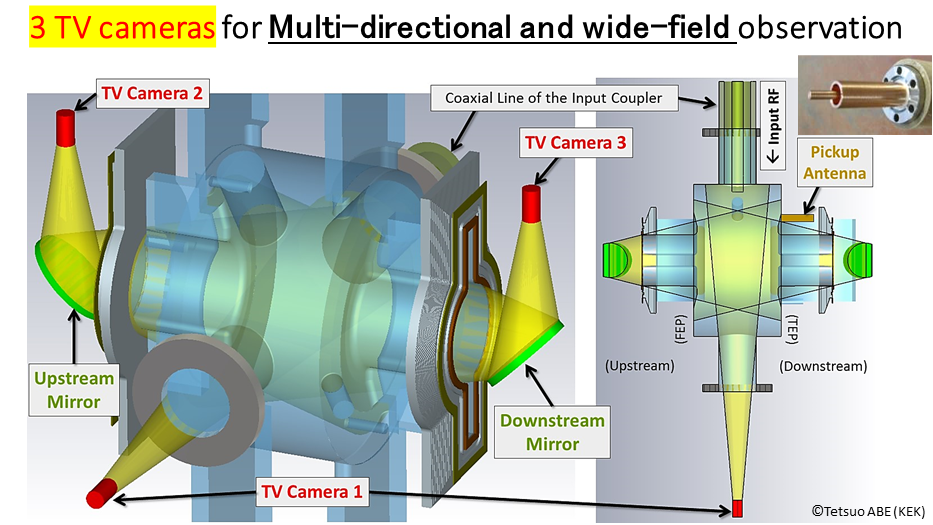
Conventional studies relied on indirect signals (RF reflection, current bursts, X-rays), making it difficult to identify the microscopic “seeds” of breakdown that are destroyed during vacuum arcs.
Approach
Key Findings
- First visual confirmation of microscopic breakdown trigger seeds. eg.1, eg.2
- Discovery and demonstration that vacuum breakdown in UHF-band continuous-wave cavities is primarily caused by “fireballs”.
Selected Publications & Presentations
- T. Abe, "Fireball Hypothesis for the Trigger of Sudden Beam Losses at SuperKEKB", presented at the 20th Annual Meeting of Particle Accelerator Society of Japan (PASJ 2023),PASJ2023-TUP01, 2023.
- T. Abe, "Direct Observation of Breakdown Phenomena in Normal-Conducting Accelerating Structures: 509-MHz Continuous-Wave Cavity and 11.4-GHz Pulsed-Wave Cavity", presented at the 12th International Workshop on Breakdown Science and High Gradient Technology (HG2019), June 2019.
- T. Abe et al., "Direct Observation of Breakdown Trigger Seeds in a Normal-Conducting RF Accelerating Cavity", Physical Review Accelerators and Beams 21, 122002, 2018.
- T. Abe, "Minuscule Gremlins Cause Vacuum Breakdown in Radio-Frequency Accelerating Cavities", Web article of KEK / Accelerator Laboratory 2019/1/22
- T. Abe et al., "Experimental RF Breakdown Study based on Direct In-situ Observation of Normal-Conducting Accelerating Cavities", presented at the 15th Annual Meeting of Particle Accelerator Society of Japan (PASJ 2018), WEOL01, Nagaoka, August 7-10, 2018.
- Paper (complete version in English).
- Presentation slides (in Japanese). - T. Abe, "Updated Results of Breakdown Study for 509-MHz Continuous-Wave Accelerating Cavities based on Direct In-situ Observation", presented at the 7th International Workshop on Mechanisms of Vacuum Arcs (MeVArc 2018), Puerto Rico, May 20-24, 2018.
- T. Abe, et al., "Breakdown Study Based on Direct In-Situ Observation of Inner Surfaces of an RF Accelerating Cavity during a High-Gradient Test", Physical Review Accelerators and Beams 19, 102001, 2016.
- T. Abe, "Visual Imaging of Radio-Frequency Cavity Breakdown", Web article of KEK / Accelerator Laboratory: English and Japanese, 2016.
2. Development of Longitudinally-Split High-Gradient Accelerating Structures (2011– )
Overview
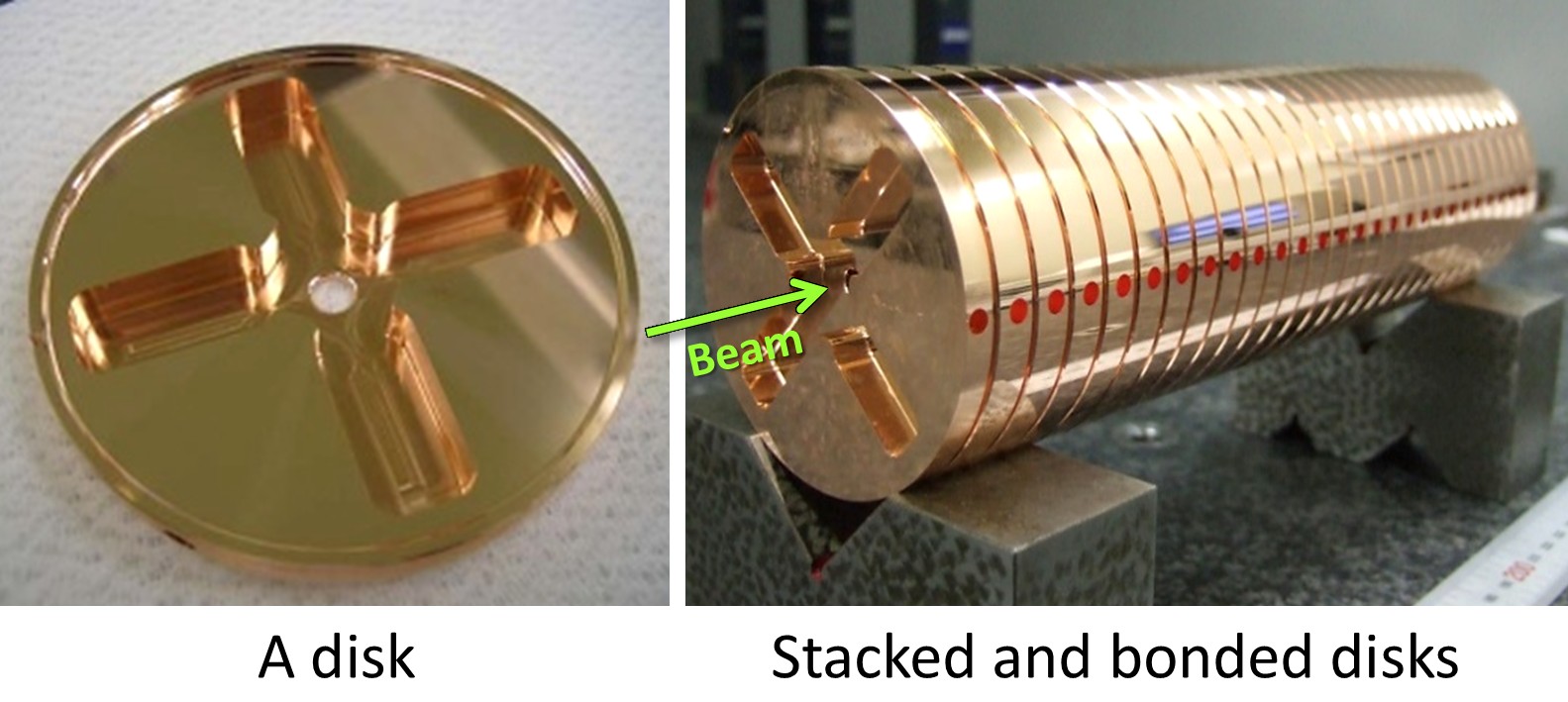
High-gradient accelerating structures traditionally use the disk-type geometry, which suffers from large number of parts (disks), and surface-current–induced breakdown risks.
Challenge
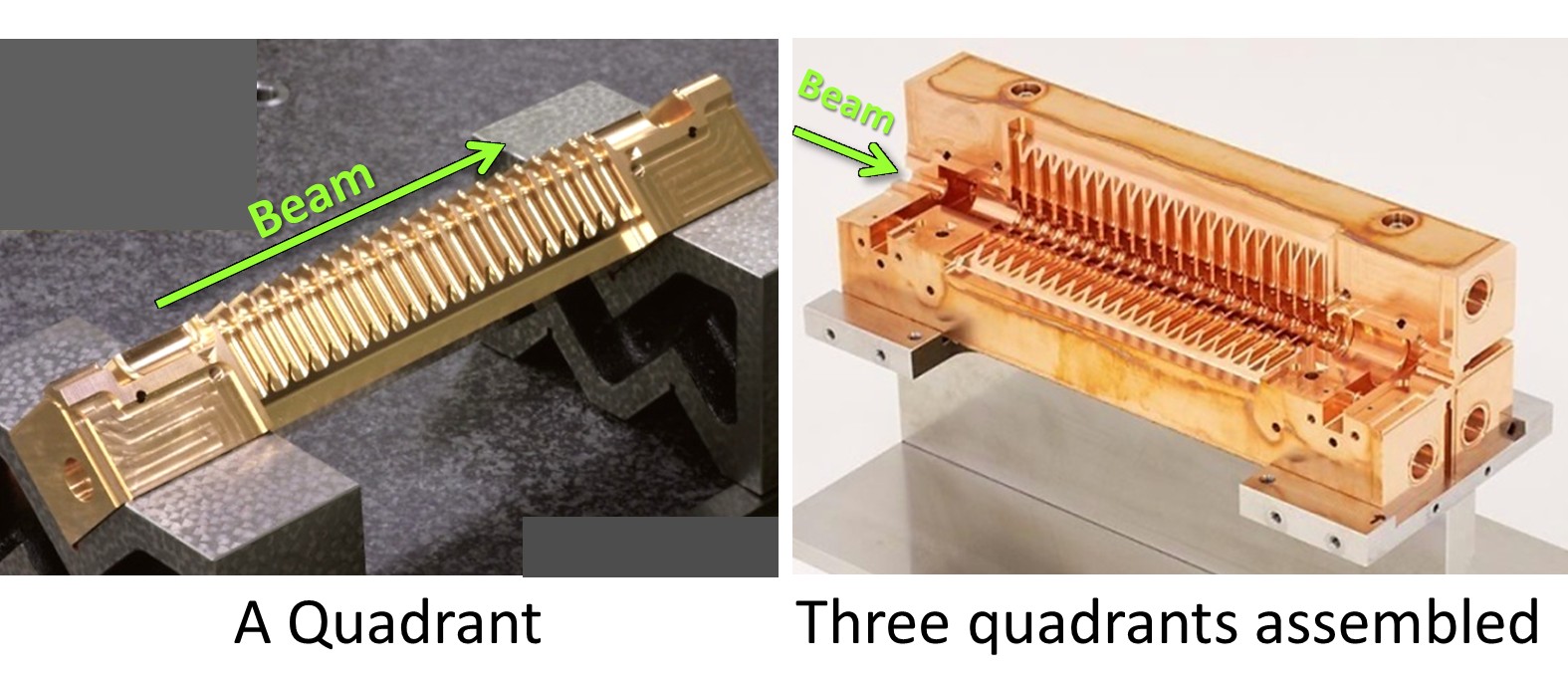
A naive quadrant-type structure (longitudinal split) tested in 2009 failed probably due to field enhancements and virtual-leak issues.
Approach
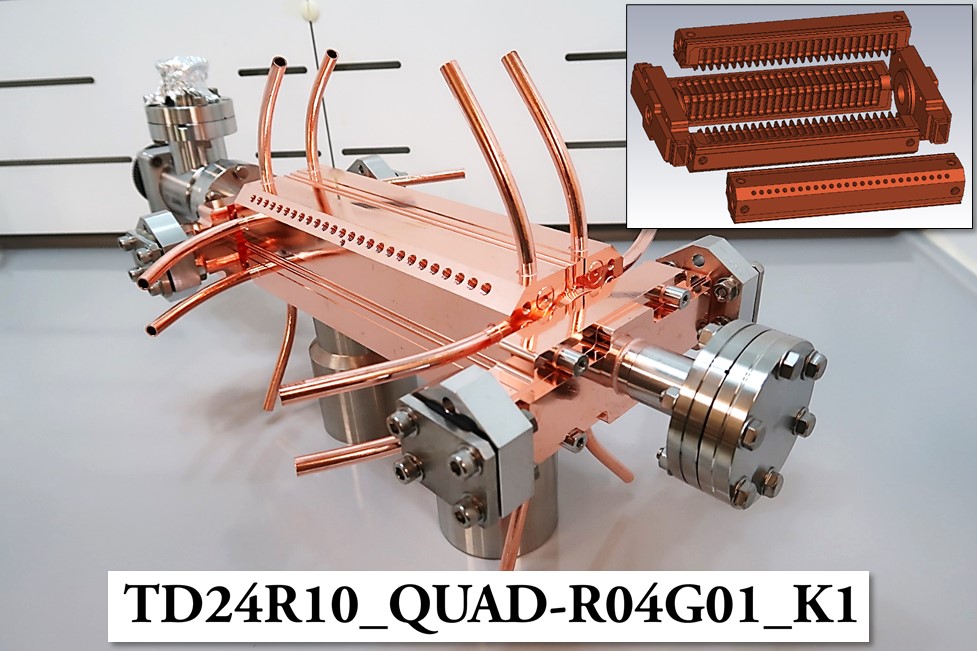
I proposed the Improved Quadrant-Type Structure, optimized through simulation:
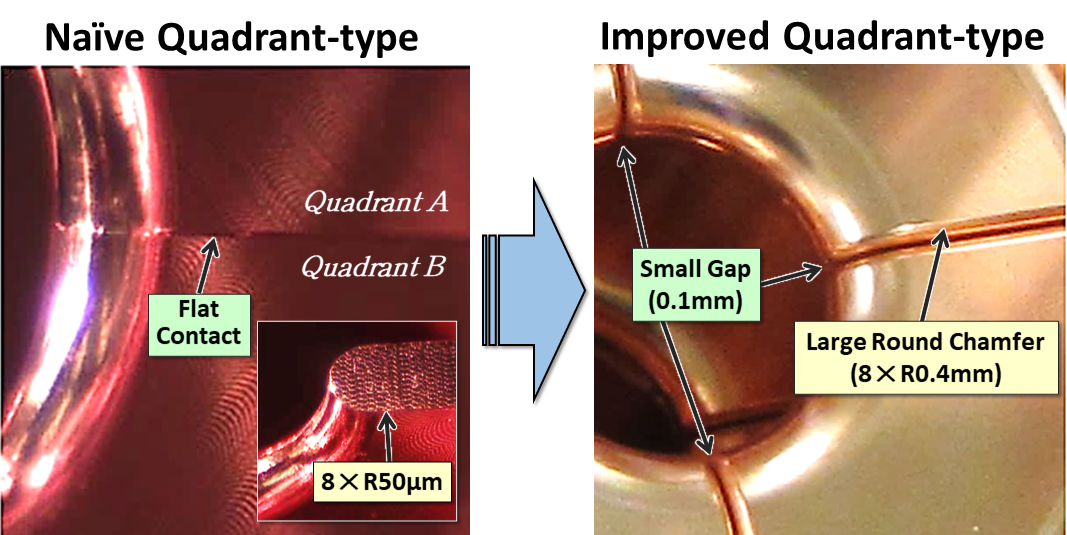
- 0.4 mm rounded chamfer to suppress field enhancement
- 0.1 mm inter-quadrant gap to avoid virtual leaks
Key Findings
- Fabrication of a single-cell X-band cavity demonstrated the new design.
- High-gradient test in 2017 demonstrated performance for ≥100 MV/m gradients with sufficiently low breakdown rates required for linear colliders.
- Fabrication of CLIC-type 24-cell accelerating strcuture based on the new design demonstrated.
Selected Publications & Presentations
- T. Abe et al., "Design and Test of C-band Compact Accelerating Structure made of Longitudinally-Split Two Halves", presented at the 21st Annual Meeting of Particle Accelerator Society of Japan, PASJ2024-FROT05, 2024.
- Paper (in English)
- Presentation slides (in Japanese). - T. Abe et al., "Fabrication of Improved Quadrant-type X-band High-Gradient Accelerating Structures", presented at the 16th Annual Meeting of Particle Accelerator Society of Japan, WEOH04, 2019.
- Paper (in English)
- Presentation slides (in Japanese). - T. Abe et al., "High-Gradient Test Results on a Quadrant-Type X-Band Single-Cell Structure", presented at the 14th Annual Meeting of Particle Accelerator Society of Japan, WEP039, 2017.
- Paper (in English).
- Presentation poster (in Japanese). - T. Abe, "High-Gradient Testing of X-Band Single Cell Test Structures at KEK/Nextef", presented at LCWS2016, 2016.
- T. Abe, "Basic Study on High-Gradient Accelerating Structures at KEK/Nextef", presented at the International Workshop on Breakdown Science and High Gradient Technology (HG2015), 2015.
- T. Abe et al., "Fabrication of Quadrant-Type X-Band Single-Cell Structure used for High Gradient Tests", presented at the 11th Annual Meeting of Particle Accelerator Society of Japan, SUP042, 2014.
- T. Abe et al., "Quadrant-Type X-Band Single-Cell Structure for High Gradient Tests", presented at the 9th Annual Meeting of Particle Accelerator Society of Japan, THPS095, 2012 (in Japanese).
- T. Abe, "Surface Field Calculations for Microscopic Defects", presented at LCWS2011, 2011.
- T. Abe, "Study of Surface Field Enhancements due to Fine Structures", presented at the 8th Annual Meeting of Particle Accelerator Society of Japan, TUPS086, 2011.
- T. Abe, "Numerical Calculations of Field Enhancements due to Small Grooves", presented at the 5th Collaboration Meeting on X-band Structure Design and Test Program held by SLAC, 2011.
3. Space-Saving 509-MHz Accelerating Structure for the SuperKEKB Positron Damping Ring (2010–2018)
Overview
Increasing the required accelerating voltage for the SuperKEKB Damping Ring necessitated multiple cavities in a space designed for one.
Challenge
Achieving ≥1.4 MV total voltage within the extremely limited RF-section footprint.
Approach
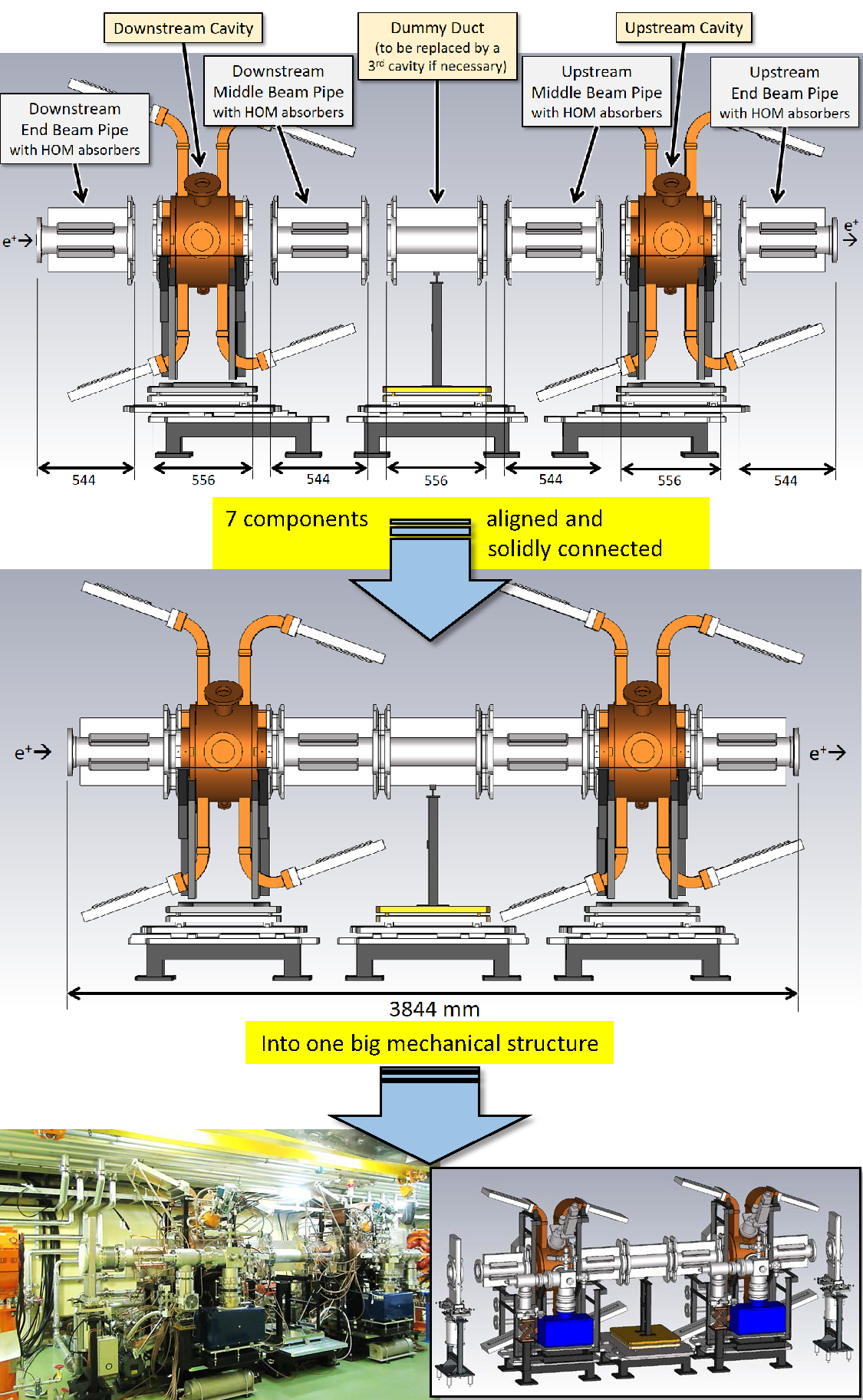
I developed a compact accelerating structure allowing installation of up to three cavities, featuring:
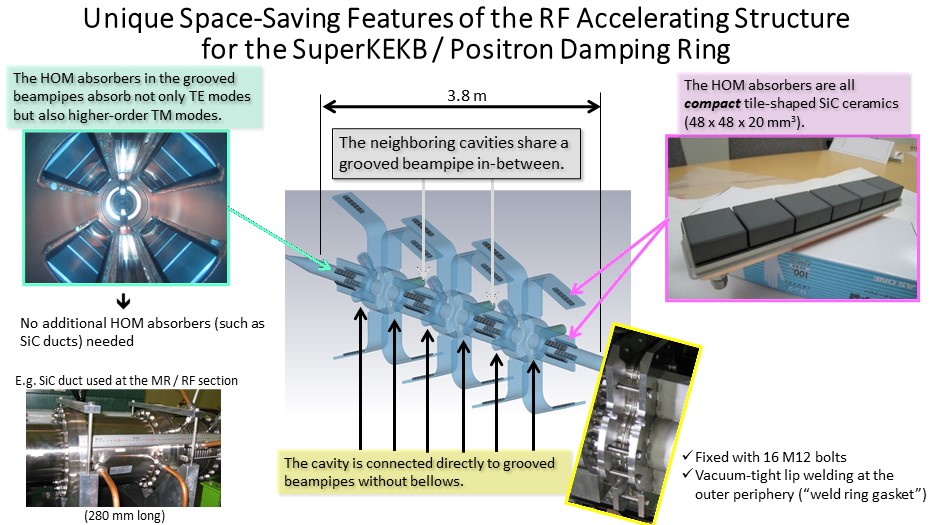
- Tile-shaped SiC HOM absorbers
- Shared grooved beam pipes
- Bellow-less direct connections
- Optimization allowing damping of TE and higher-order TM modes
Key Findings
- Successful high-power performance: 0.95 MV per cavity
- Two production cavities installed with <0.3 mm alignment error
- Stable positron acceleration achieved in actual DR operations
Selected Publications & Presentations
- T. Abe, "Status of RF Accelerating Cavities for SuperKEKB Positron Damping Ring", presented at the 22th KEKB Accelerator Review Committee meeting, 2018.
- T. Abe et al., "Installation of Normal-Conducting RF Accelerating Cavities into the SuperKEKB Positron Damping Ring", presented at the 14th Annual Meeting of Particle Accelerator Society of Japan, TUOL06, 2017.
- Presentation slides (in Japanese). - T. Abe et al., "Test Results on RF Accelerating Cavities for the Positron Damping Ring at SuperKEKB", presented at the 11th Annual Meeting of Particle Accelerator Society of Japan, SAP050, 2014.
- T. Abe, "Status of the Normal Conducting Accelerating Cavities for the MRs and DR of SuperKEKB in JFY2013", presented at the 19th KEKB Accelerator Review Committee meeting, 2014.
- T. Abe, "Completion of the First Production Version of the Accelerating Cavity for the SuperKEKB Positron Damping Ring", Web article of KEK / Accelerator Laboratory: English and Japanese, 2013.
- T. Abe et al., "High Power Testing of the RF Accelerating Cavity for the Positron Damping Ring at SuperKEKB", presented at the 10th Annual Meeting of Particle Accelerator Society of Japan, SAP057, 2013 (in Japanese).
- T. Abe, "Normal Conducting Accelerating Cavities for the MRs and DR of SuperKEKB", presented at the 18th KEKB Accelerator Review Committee meeting, 2013.
- T. Abe et al., "Development of RF Accelerating Cavity for the Positron Damping Ring at SuperKEKB", presented at the 9th Annual Meeting of Particle Accelerator Society of Japan, THLR06, 2012 (in Japanese).
- Presentation slides (in Japanese). - T. Abe, "Status of the RF Accelerating Cavity for the Damping Ring", presented at the 17th KEKB Accelerator Review Committee meeting, 2012.
- T. Abe et al., "RF Accelerating Structure for the Positron Damping Ring of the SuperKEKB Injector", presented at the 8th Annual Meeting of Particle Accelerator Society of Japan, TUPS131, 2011 (in Japanese).
- T. Abe, "Accelerating Cavities for the Damping Ring", presented at the 16th KEKB Accelerator Review Committee meeting, 2011.
- T. Abe, "Development of RF Accelerating Structure for the Damping Ring of the SuperKEKB Injector (simulation aspects)", presented at workshop on Advanced 3D EM and Particle Simulation Technology, hosted by AET & CST, 2010.
- T. Abe et al., "RF Accelerating Structure for the Damping Ring of the SuperKEKB Injector", presented at IPAC'10, WEPE087, 2010.
4. Multipactoring-Free High-Power Input Coupler for High Beam-Current Storage Rings (2004–2010)
Overview
Multipactoring in coaxial input couplers caused severe issues during KEKB operations.
Challenge
Standard coaxial lines are prone to multipactoring due to their field uniformity, even when replaced with new components.
Approach
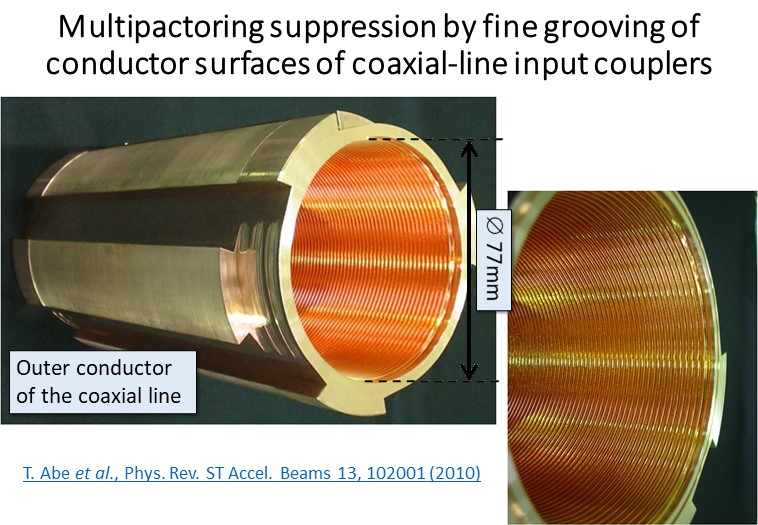
I introduced fine surface grooving on conductor surfaces to suppress multipactoring under heavy beam loading and developed dedicated simulation tools to optimize the groove design.
Key Findings
- Complete suppression of multipactoring demonstrated in a test stand and KEKB beam operations
- Effectiveness of multipatterning suppression demonstrated for all of the more than 10 grooved RF input couplers manufactured subsequently
- Groove structure adopted as the official standard for ARES-cavity input couplers
Selected Publications
- T. Abe et al., "Multipactoring Suppression by Fine Grooving of Conductor Surfaces of Coaxial-Line Input Couplers for High Beam Current Storage Rings", Physical Review ST Accel. Beams 13, 102001, 2010.
- T. Abe, "Upgrade of High-Power Input Coupler for SuperKEKB", private presentation slides, 2008 (in Japanese).
- T. Abe, et al., "Multipactoring Zone Map of an RF Input Coupler and its Application to High Beam Current Storage Rings", Physical Review ST Accel. Beams 9, 062002, 2006.
- T. Abe et al., "Fine Grooving of Conductor Surfaces of RF Input Coupler to Suppress Multipactoring", presented at EPAC'06, TUPCH127, 2006.
- T. Abe et al., "Development of RF Input Coupler with a Coaxial Line TiN-Coated Against Multipactoring", presented at PAC'05, TPPT006, 2005.
5. Synchrotron-Radiation Background Estimation Based on Real Beam Orbits (2001–2007)
Overview
Synchrotron radiation from accelerator beams can severely damage particle detectors.
Challenge
Previous estimation methods lacked precision and could not reproduce real detector accidents.
Approach
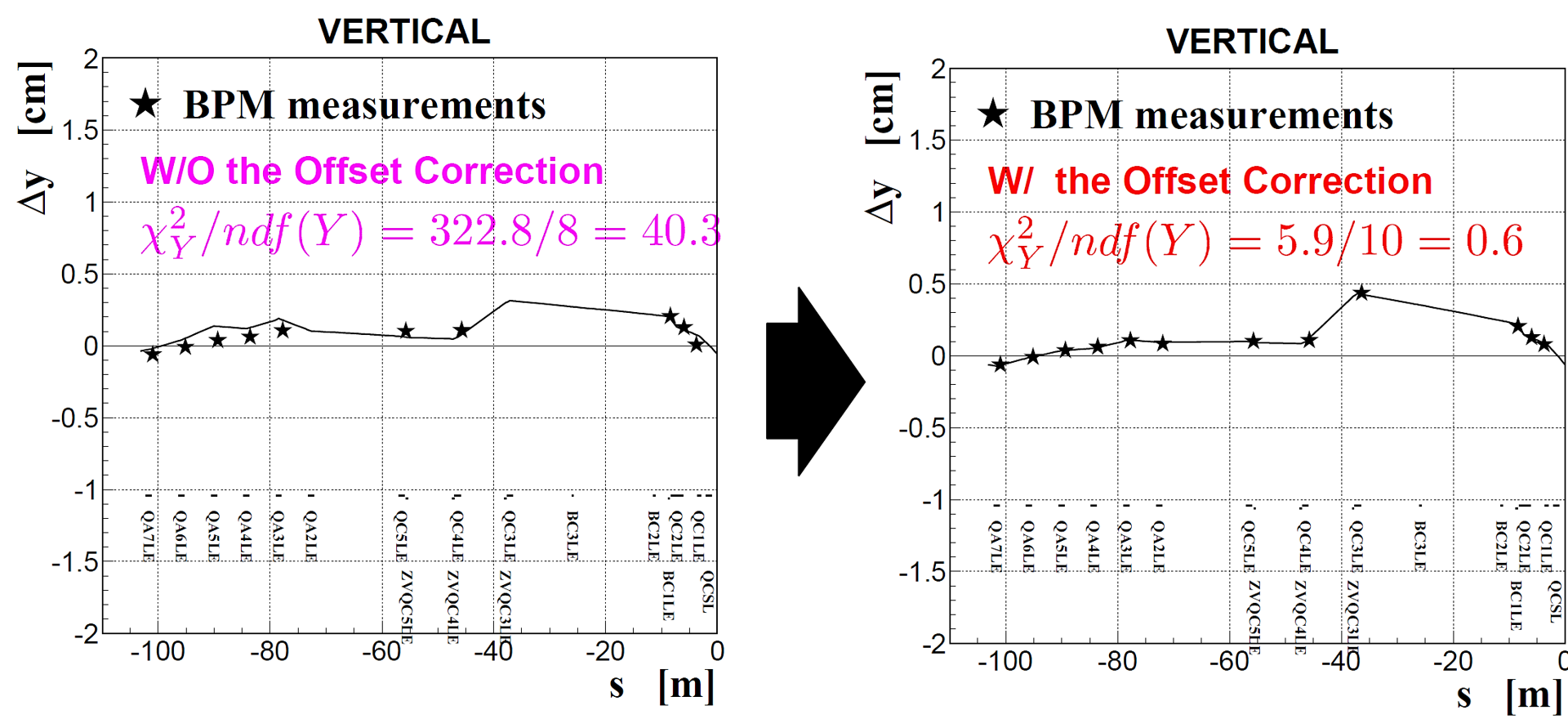
Developed a new SR calculation method based on globally-fitted real beam orbits, incorporating realistic offset corrections.
Key Findings
- Successfully reproduced the Belle/SVD gain-drop accident
- Demonstrated feasibility for background alarm systems
Selected Publications
- T. Abe, "New Simulation Code for Synchrotron Radiation Based on a Real Beam Orbit", presented at PAC'07, THPAN034, 2007.
- T. Abe and H. Yamamoto, "Estimation of Synchrotron-Radiation Background Based on a Real Beam Orbit", Physical Review ST Accel. Beams 7, 072802, 2004.
- My presentation at EGS4 Workshop, 2002 (in Japanese).
- My presentation at KEKB Commissioning Group Seminar, 2002.
6. Data Analysis of Exclusive J/ψ Electroproduction at HERA (1999–2001)
Overview
This study explored the transition region between soft and hard QCD processes.
Approach
Measured exclusive J/ψ production cross sections in high-energy ep collisions and compared them with:
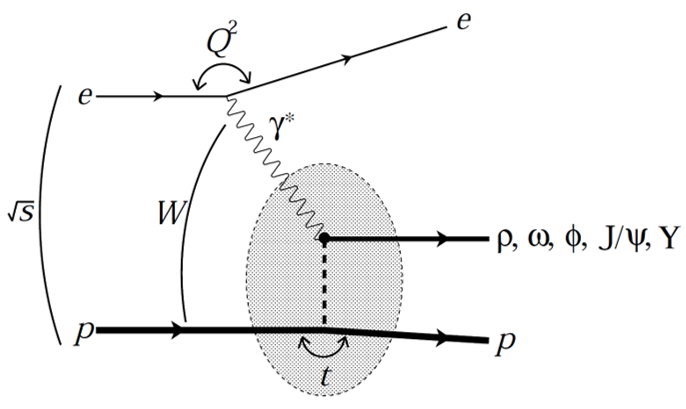
- Regge theory (soft regime)
- Perturbative QCD predictions (hard regime)
Results
- Data favored perturbative QCD models
- Demonstrated that photon virtuality and J/ψ mass serve as effective hard scales
Selected Publications
- T. Abe, "Measurement of Exclusive J/psi Electroproduction in High-Energy ep Collisions at HERA", 2001 (Revised doctoral thesis).
- T. Abe, "Measurement of Exclusive J/psi Electroproduction in High-Energy ep Collisions at HERA", presented at the Annual Meeting of Japanese Physical Society, 2001 (in Japanese).
- T. Abe, "Exclusive electroproduction of charmonium at HERA," presented at an international conference: PHOTON2000, Ambleside, England, Aug. 26-31, 2000.
7. GRAPE: Complete Monte-Carlo Generator for Dilepton Production in ep Collisions (1997–2001)
Overview
Dilepton production is an important background in many analyses, but existing generators lacked full Standard-Model coverage.
Approach
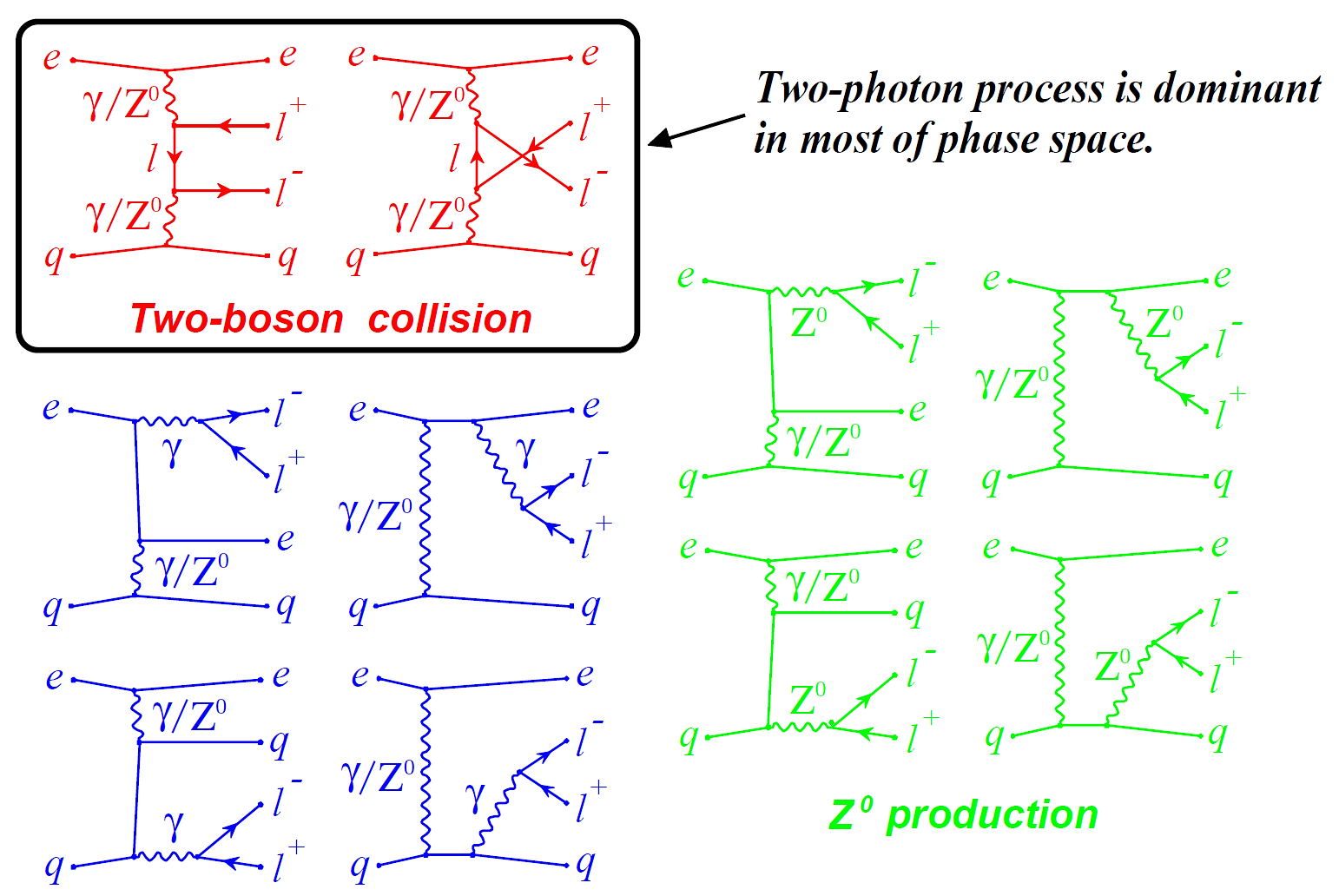
Using the GRACE automatic calculation system, I developed a generator including:
- All tree-level Feynman diagrams in the Standard Model
- Detailed proton-destruction processes
Results
- Development of the World's First “Complete Lepton Pair Generator for ep Collisions”
- Widely used in the HERA community, etc.
- Cited in 110+ scientific papers