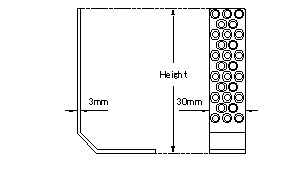
Figure 1:Shape of the C-tuner.
Resonant frequency and inter-vane voltage along beam axis were well tuned by changing locally inter-vane capacitance and stem (used for supporting the vanes) inductance. For changing the capacitance, C-tuners of the copper plates (Fig. 1) were attached on the back-plates of the vanes so that a plate confronted a stem with a distance of 25 mm. We adjusted the stem inductance by changing the area of the stem-flange windows with panels (Fig. 2). For tuning the frequency and field distribution, height of the C-tuners installed in the first, second and 12th modules was changed as shown in Table 1; the number of tuners is four per module. Height of the panels before and after tuning is summarized in Table 2.
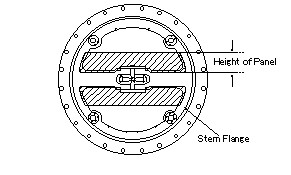
Figure 2:Panels attached on the stem flange.
| 1st module | 2nd module | 12th module | |
| Height of C-tuners before tuning (mm) | 170 | 120 | 120 |
| Height of C-tuners after tuning (mm) | 170 | 70 | 95 |
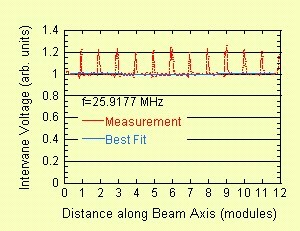
Figure 3:Longitudinal inter-vane voltage distribution.
| before tuning | after tuning | ||
| Positions of the stem flanges | Height of panels | Positions of the stem flanges | Height of panels |
| Between 3rd and 4th modules | 0mm | Between 3rd and 4th modules | 136.5mm |
| Between 6th and 7th modules | 125mm | Between 6th and 7th modules | 136.5mm |
| Between 9th and 10th modules | 0mm | Between 9th and 10th modules | 136.5mm |
Values of the capacitance and inductance to be changed were estimated by using an equivalent circuit analysis [2]. For the inter-vane voltage measurements, a Teflon perturbing object of a square plate, 30×30×8mm3, was moved along two vanes used as a guide. Figure 3 shows the measured longitudinal inter-vane voltage distribution of the SCRFQ.
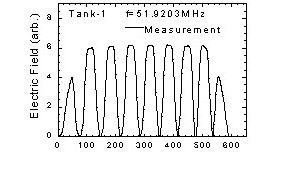
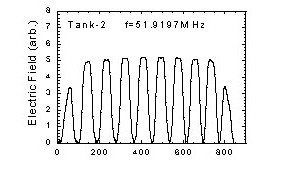
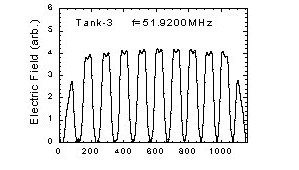
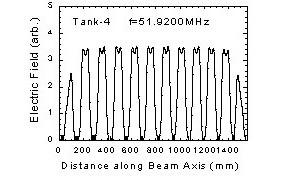
Figure 4:Electric field distributions.
The resonant frequencies were tuned by increasing the gap lengths between drift-tubes, that is, by decreasing the capacitance. For increasing the gap length, the drift-tube length was shortened. All drift-tubes except end drift-tubes were replaced to the modified ones. Dimensions of the drift-tubes were finally determined by model tests after rough estimations by MAFIA calculations [3].
Each cavity of IH Linac has a capacitive tuner and a inductive one. They change the frequency 100 or 150 kHz. Therefore, we tuned the frequency to the goal one with an accuracy better than ±50kHz . For the field measurements, a perturbing bead was moved along the beam axis. The bead is an aluminum sphere of 6.3 mm in diameter. Figure 4 shows the measured electric field distributions along beam axes of the IH cavities.